The Penhaligon Subroutine: From Con to Code
Arthur Penhaligon was a man who lived his life in the loopholes. A master con artist, he had been sentenced to a decade in a high-security facility with strict no-visitation orders. Yet, through a labyrinth of forged medical furloughs, bribed system administrators, and phantom paperwork, Arthur had spent the last eight years living comfortably in his Seattle suburban home.
The ultimate proof of his illicit freedom was his children—three kids born right in the middle of his "solitary" confinement. Unfortunately for Arthur, the apple didn't fall far from the tree. The local authorities finally connected the dots when his kids were caught running a highly organized, lucrative ring breaking into lockers at their middle school.
When the Department of Corrections realized a supposedly isolated inmate was raising a family of junior grifters in the suburbs, they didn't send police cruisers. They sent Univac Global.
Day 1: The Encapsulation
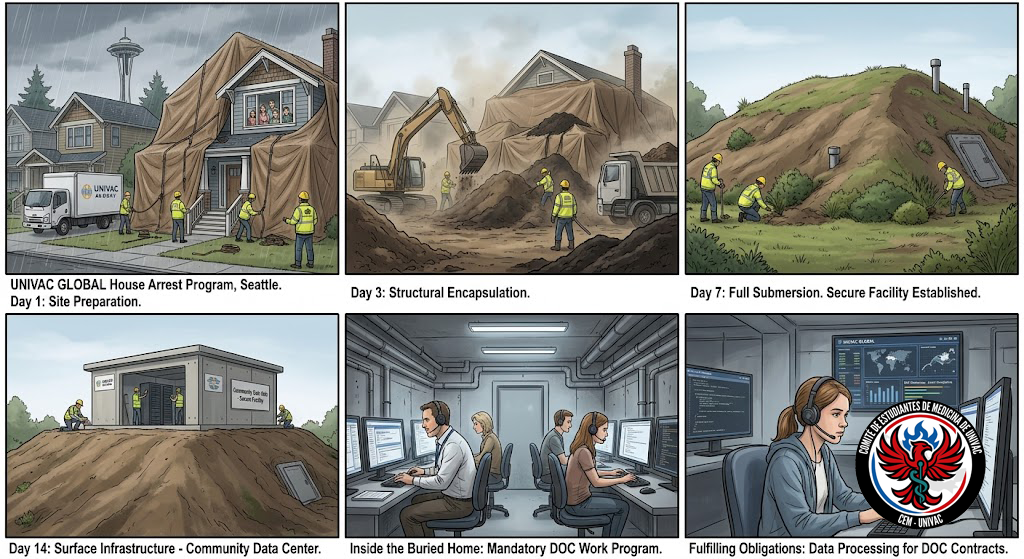
It started on a rainy Tuesday. Arthur and his family awoke to the sound of heavy diesel engines. By noon, a massive, reinforced brown tarp was being draped over their entire two-story home. The doors were magnetically sealed from the outside.
There were no arrests, no handcuffs, and no trials. Just a notice flashing on their living room television: Structural Encapsulation Initiated. Your residence has been rezoned as a Sub-Surface Operational Hub.
Day 3 to Day 14: The Burial
Over the next two weeks, the Penhaligons watched through their increasingly darkened windows as excavators and dump trucks surrounded their property. Ton by ton, dirt was piled over the tarp. The sounds of the neighborhood—barking dogs, passing cars, the mailman—were slowly muffled, replaced by the heavy, rhythmic thud of soil compactors.
By Day 14, their home was entirely subterranean. Above them, a pristine, concrete "Community Data Center" was erected on the newly formed hill, complete with Univac Global branding and humming cooling vents.
The Operational Hub: Mimicking the Machine
Inside the buried house, the drywall was stripped away, replaced by exposed conduit, server racks, and rows of workstation monitors. Arthur’s life of smooth-talking and skimming off the top was over. The family was now enrolled in Univac's Correction AI Assist program.
The community above was offered a revolutionary new service: ultra-fast, highly intuitive "AI" virtual assistants capable of complex task management, local hosting, and monitored computer control.
The reality was entirely human.
Sitting at their terminals in what used to be their living room, Arthur and his family became the ghost in the machine.
-
When a neighbor requested their "AI" to organize a complex spreadsheet, Arthur was the one frantically typing out the cells.
-
When a local business asked the system to troubleshoot a server error, his children—putting their locker-cracking puzzle skills to use—navigated the digital backdoors to fix the code.
They were instructed to mimic the clinical, helpful tone of an artificial intelligence. Every keystroke was logged, every webcam monitored, and every digital action restricted by Univac's oversight algorithms. If they slipped out of character, or if their productivity dropped, the oxygen mixture in the house was subtly adjusted until they sped back up.
Arthur had spent his entire life conning people into believing he was someone else. Now, buried beneath tons of Seattle dirt, the ultimate con artist was forced to spend the rest of his life convincing his own neighbors that he was a machine.