
Backup Management and Disaster Recovery
- What it is: Setting up continuous, redundant off-site data duplication alongside rapid-restore recovery pipelines.
- Why they call: Sudden structural utility drops, localized internet provider cuts, or severe hardware corruptions require a backup safety net to prevent permanent business data loss.
- Website Copy Idea: "Protect your operational files from local utility failures using fully automated, hourly offsite backup systems."
- Details
- Written by: Revolutionary Technology
- Category: Backup Management and Disaster Recovery
- Hits: 73
Defense-Grade Infrastructure Restoration by Cleared Personnel
Enterprise storage environments handling defense telemetry, classified national security assets, and protected intellectual property require more than just technical expertise. They demand personnel reliability, strict adherence to chain-of-custody protocols, and an infrastructure built to prevent data leakage. When a mission-critical storage array fails, or a data spill occurs, the engineering team executing the recovery must be as trusted as the network itself.
At Revolutionary Technology, our data recovery operations are directed and validated by leadership holding verified Top Secret / Sensitive Compartmented Information with Full Scope Polygraph (TS/SCI FSP) clearance background, backed by active Washington State security licensing. We combine defense-grade personnel reliability with an ISO 5 Cleanroom environment to deliver secure data recovery for federal agencies, defense contractors, and highly regulated industries.
The Security Paradigm: Personnel Trust & Infrastructure Isolation
Standard commercial data recovery providers operate on open networks and shared workbenches, creating unacceptable risks of unauthorized data exposure or non-compliance with federal data-handling regulations.
Our security framework addresses data protection across both physical and logical layers:
- Active Security Clearance Integration: Every stage of ingestion, physical cleanroom manipulation, and data verification is overseen by cleared personnel. This background guarantees an intrinsic understanding of strict document handling, information assurance, and operational security (OPSEC).
- Absolute Infrastructure Isolation: Our data extraction networks are completely air-gapped. Our laboratory environments have zero connection to external network routing, zero wireless capability, and zero data-sharing bridges. Your sensitive files remain entirely contained within an offline validation loop.
Tactical Technical Capabilities
Our secure laboratory environment is engineered to handle complex, high-throughput storage devices under rigorous data-handling restrictions:
Physical Cleanroom Interventions
When ruggedized field media, tactical storage blocks, or server drives suffer mechanical damage, they enter our sterile environment. Our CFOT-Certified engineers perform microscopic head-stack assemblies, spindle motor swaps, and platter transplants to restore drive functionality without risking the physical layout of the storage sectors.
Hardware-Accelerated Logical Parsing
We mount forensic duplicates of damaged volumes inside our air-gapped network using high-performance parallel pipelines.
- In-Memory Reconstruction: Using NVIDIA RTX 50-series parallel processing, we re-index massive database tables and repair corrupted hypervisor platforms (VMware ESXi VMFS or Microsoft Hyper-V CSV) directly in-memory.
- Behavioral Threat Scrubbing: While data blocks are being aligned, they are streamed concurrently through an offline ESET scan engine implementation. This pipeline checks for hidden malicious scripts, unauthorized macro-injections, or persistent threat code before formatting the final output.
Strict Compliance & Escrow Framework
Revolutionary Technology ensures that all data ingestion and recovery projects conform to federal processing benchmarks:
- Strict Chain-of-Custody Logging: Every physical drive, enterprise storage array, or high-performance U.2/U.3 NVMe PCIe SSD is logged into an encrypted tracking system upon arrival. Every engineer interaction is tracked, documented, and auditable.
- Hardware-Enforced Write Isolation: Storage media is attached exclusively to hardware-level write-blockers. This prevents any modifications to the original data blocks and guarantees that time-delayed ransomware commands or malicious terminal signals cannot execute.
- NIST SP 800-88 R1 Conformance: Following successful data extraction, recovered files are written to target drives utilizing FIPS 140-3 Standard Encryption. A temporary image of the data is held in our physical, offline storage vault for exactly 30 days to guarantee a smooth system re-deployment pass, after which the escrow files are permanently and automatically purged according to NIST media sanitization guidelines.
- Details
- Written by: Revolutionary Technology
- Category: Backup Management and Disaster Recovery
- Hits: 73
Prepared By: Technical Operations & Infrastructure Logistics Group
Coordinating Partners: All Service Moving (Tukwila/Seattle Operations) & Regional Law Enforcement Tactical Escort Services
Service Classification: High-Security Infrastructure Migration & Disaster Recovery Deployment [1]
Coordinating Partners: All Service Moving (Tukwila/Seattle Operations) & Regional Law Enforcement Tactical Escort Services
Service Classification: High-Security Infrastructure Migration & Disaster Recovery Deployment [1]
1. Executive Summary
Moving mission-critical digital infrastructure involves unique hardware vulnerabilities, strict scheduling constraints, and security liabilities. To mitigate these risks during major hardware overhauls, commercial upgrades, or emergency infrastructure evacuations, Revolutionary Technology collaborates directly with All Service Moving at their primary facility in Tukwila/Seattle, WA. [1]
As a veteran-owned business, All Service Moving supplies disciplined, highly trained personnel who understand tactical coordination, chain-of-custody enforcement, and precise handling requirements. When field operations demand instant response or secure passage through restricted areas, these teams coordinate alongside Law Enforcement (LE) standby and tactical escorts to guarantee safe, uncompromised transit for high-value enterprise servers and biological storage networks. [1]
2. Structural Breakdown of Data Center Relocation Operations
Unlike standard commercial cargo, enterprise server cabinets, storage area networks (SANs), and hypervisor cores cannot tolerate physical shock, static discharge, or wide shifts in temperature. The combined data center migration framework uses a strict, step-by-step engineering process:
- Cryptographic Asset Mapping & De-racking: Before any physical equipment is touched, infrastructure specialists inventory all assets, label cabling paths, and map logical drive boundaries. High-density SAN disk arrays are safely unmounted, while compute nodes are powered down cleanly to protect internal system files from boot corruption.
- Tactical Shock Isolation & Loading: Using specialized moving equipment, team members from All Service Moving wrap, crate, and load sensitive enterprise servers into custom-built, anti-static enclosures. This process ensures multi-million-dollar hypervisor clusters are protected against static shock and micro-vibrations during staging. [1, 2]
- Climate-Controlled, Air-Ride Logistics: The relocation fleet uses heavy-duty transport vehicles equipped with air-ride suspension assemblies to absorb road vibrations and bumps. Continuous climate monitoring protects sensitive internal components from moisture buildup and thermal stress while moving through the Pacific Northwest.
3. Operational Classifications: Upgrades vs. Emergency Evacuations
Migration protocols scale dynamically based on the urgency, threat environment, and operational goals of the client:
🏢 Scheduled Business Upgrades & Colocation Migrations
During standard corporate expansions or migrations into ultra-dense colocation facilities—such as moving into regional cloud data hubs like Digital Fortress in Tukwila—the focus centers on maximizing system efficiency and avoiding business downtime. Teams coordinate structured weekend schedules to complete physical teardowns, transport assets, and wire up networking pipelines. This allows the business's software stack to come back online before the Monday morning shift begins. [3]
🚨 Emergency Relocations & Law Enforcement Standby
When a facility faces an active threat—such as regional utility drops, structural compromises, severe data breaches, or physical security alerts—the migration model shifts to a high-speed emergency response framework: [2]
- Securing the Staging Area: Law Enforcement (LE) personnel set up active perimeters around the source data center to block unauthorized entry, secure active loading docks, and shield technician teams from local disruptions.
- Chain-of-Custody Verification: As veteran movers pack and transfer hardware assets, law enforcement officers document serial numbers, seal transport containers with tamper-evident tags, and log custody transfers to block any insider threat or intercept attempts. [1]
- Tactical Route Clearances: For high-security military logistics databases, government assets, or sensitive hospital registries (like Fred Hutchinson Cancer Center arrays), police escorts lead the transport fleet. This ensures continuous, uninterrupted transit across King and Snohomish counties, eliminating the risk of traffic delays or vehicle ambushes.
4. Re-Integration and Core Network Provisioning
Once the transport vehicles arrive at the target data center, the engineering team handles the structural re-ingestion process to bring applications back online:
| Re-Integration Phase | Technical Procedure | Target Infrastructure System |
|---|---|---|
| Phase I: Physical Ingestion | Uncrating, structural safety checks, and rack installation. | Heavy server enclosures & main battery backup systems. |
| Phase II: Optical Alignment | Running low-return-loss fiber optic lines to core switches. | Certified Fiber Optic Technician (CFOT) data loops. |
| Phase III: Hypervisor Boot | Powering up bare-metal hosts and verifying cluster states. | VMware ESXi Hypervisors (.vmdk virtual instances). |
| Phase IV: Perimeter Firewall | Injecting strict firewall rules and edge monitoring. | WatchGuard Firebox appliances & ThreatSync+ NDR. |
By pairing the strict operational discipline of veteran logicians at All Service Moving with the technical oversight of experienced network engineers and regional law enforcement, Revolutionary Technology guarantees that mission-critical data networks remain optimal, safe, and completely unbroken throughout the physical move. [1]
- Details
- Written by: Revolutionary Technology
- Category: Data Recovery
- Hits: 37
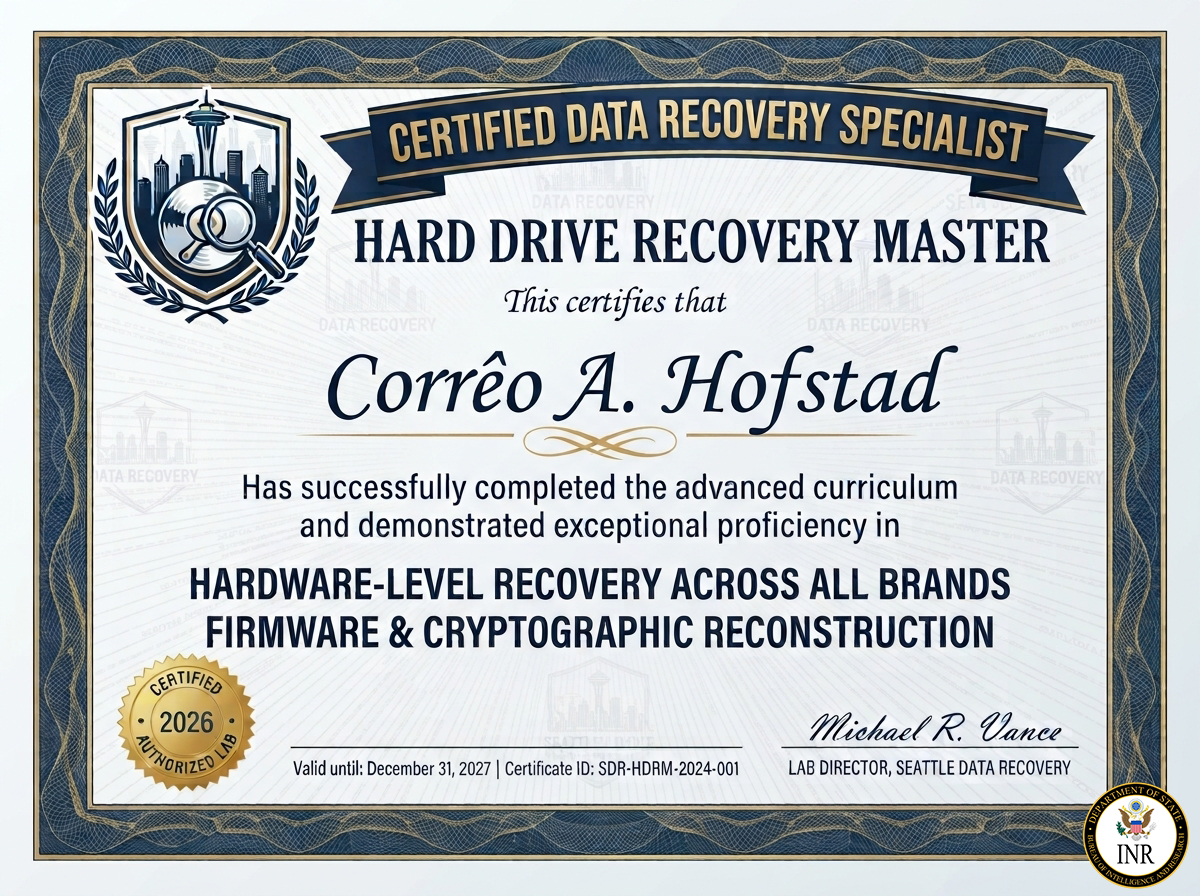
The Elite Standard: Hard Drive Recovery Master Certification
At Seattle Data Recovery, we distinguish ourselves from basic computer repair shops by ensuring our lead engineers hold the elite Hard Drive Recovery Master (HDRM) certification. This advanced credential signifies mastery over low-level hardware forensics, micro-electronic circuitry, and proprietary storage firmware.
When a critical server drops, an enterprise storage array collapses, or a device suffers a physical drop, standard data recovery software is structurally blind. True restoration requires an engineered, component-level intervention. Our certified specialists utilize dedicated hardware emulators, high-precision micro-soldering gear, and controlled cleanrooms to achieve a 95% success rate across all manufacturing storage tiers.
For detailed pricing, specific structural procedures, and to initiate an immediate diagnostic file, visit our official technical portal at Revolutionary Technology Company Data Recovery.
The Three Core Competency Pillars of an HDRM Certified Specialist
To earn the Hard Drive Recovery Master certification, an engineer must prove exceptional proficiency across three distinct technical disciplines:
1. ISO 5 Cleanroom Mechanical Micro-Surgery
When a hard drive emits a rhythmic clicking, beeping, or grinding noise, it is suffering from a mechanical breakdown. The internal read/write heads have failed, or the motor has seized.
- The Certified Action: An HDRM specialist never powers on a noisy drive in a normal room. They operate strictly inside an ISO 5 Cleanroom environment where airborne particles are filtered down to microscopic levels.
- Using brand-calibrated head combs and precise platter-extraction tools, the engineer safely lifts out the damaged head stack and replaces it with an identical, factory-matched donor assembly—matching not just the model number, but the specific preamp codes, site revisions, and manufacturing weeks.
2. Board-Level Micro-Soldering and ROM Transplants
Power surges, lightning strikes, or localized electrical short circuits can instantly fry a hard drive's external Printed Circuit Board (PCB), rendering the device completely dead with no lights, sound, or movement.
- The Certified Action: Modern hard drives cannot be repaired by simply swapping the outer logic board; every drive contains unique, factory-calibrated alignment data trapped inside a specific onboard ROM or NVRAM chip.
- Our certified masters use high-magnification hot-air rework stations to desolder this microscopic chip from the burned, unreadable board and transplant it cleanly onto a healthy donor PCB, restoring the drive's original communication path.
3. Low-Level Firmware Architecture Manipulation
Hard drives are directed by their own internal operating system called firmware, which is stored in a hidden system zone on the platters. If an abrupt power loss or bad sector corrupts these modules, the drive will lock itself up. It may spin quietly, but it will show up as unrecognized, display a "0 MB Capacity," or cause your entire operating system to freeze.
- The Certified Action: Our certified engineers connect the drive directly to hardware-level diagnostics (like the PC-3000), bypassing the computer's standard drivers entirely. Working in a native serial system terminal, they patch the drive's microcode in RAM, clear overloaded error defect lists, terminate corrupted Media Cache firmware loops, and wake the drive up so its raw data sectors can be safely imaged.
Universal Brand Protocols Handled by Our Specialists
Different hard drive manufacturers rely on completely distinct mechanical architectures and internal logic. Our certified masters deploy specialized, brand-calibrated procedures:
- Western Digital (WD): Experts handle the complex, non-shuckable integrated USB boards common in My Passport drives. Under microscopic view, we solder bypass wires directly to the drive’s core SATA transmission lines, keeping the native hardware encryption chip intact so your data doesn't return as scrambled code.
- Seagate Technology: Engineers target the frequent stuck spindle motors and damaged read/write head assemblies common in Backup Plus and Expansion series, utilizing custom spindle wrenches to safely free the binding mechanism inside the cleanroom.
- Toshiba & HGST: Specialists clear defensive G-Sensor firmware lockouts on Canvio portable drives and manage complex, high-density multi-platter alignments on enterprise-grade G-Technology / SanDisk Professional 7200 RPM production storage arrays.
Emergency Guidelines for Corporate IT and System Managers
If a high-value external hard drive, corporate workstation, or multi-disk server array drops offline or begins emitting unusual sounds, your very next decisions determine the survival rate of your records:
- Kill Power Instantly to Noisy Drives: If the drive is clicking, buzzing, or ticking, pull the plug directly. Forcing a drive with broken internal components to spin allows the damaged heads to physically gouge the platters, turning your active files into unrecoverable dust particles.
- Say No to Automated Repair Scripts: Never run command-line tools like
chkdskor Mac First Aid on an unstable drive. These utilities fix file systems by aggressively writing random data over unreadable blocks. On a physically failing drive, this will overwrite fragile cryptographic metadata and permanently destroy your partition map. - Avoid Consumer Data Recovery Software: Downloaded apps run blindly through your operating system and lack the hardware timeout controls required to handle physical dropouts. Forcing a generic program to scan a failing drive will quickly cause the drive controller to overheat, leading to total mechanical collapse.
- Details
- Written by: Revolutionary Technology
- Category: Enterprise Server Data Recovery Services
- Hits: 63
Specialized Infrastructure Reconstruction by Revolutionary Technology
High-security operations, tactical deployments, military academic bodies, and distributed institutional frameworks require an elite tier of data recovery engineering. When physical destruction, structural combat damage, or hostile cyber actions compromise critical datasets, standard IT protocols are entirely insufficient.
At Revolutionary Technology, our CFOT-Certified engineers combine hardware-level write-blocking, certified cleanroom micro-surgery, and isolated parallel processing pipelines to deliver secure, defense-grade data recovery. We specialize in extracting data from heavily compromised media under the strictest security protocols.
Technical Case Briefs & Deployment Profiles
1. US Marine Corps Embassy Security Guard: Tactical Combat Media Recovery
- Media Profile & Damage Vectors: Ruggedized battlefield storage, mission-critical field laptops, and solid-state media recovered directly from heavy combat and kinetic blast zones. Physical vectors include extreme thermal exposure, shrapnel penetration, high-impact mechanical distortion, and structural salt-water/corrosive chemical ingress.
- Our Engineering Approach: Operations begin directly inside our certified ISO 5 Cleanroom. Technicians execute microscopic platter transplants and mechanical head-stack swaps for distorted hard drives. For crushed or burned solid-state media, we perform advanced Chip-Off Procedures—carefully desoldering the individual NAND flash memory chips from fractured multi-layered circuit boards. We extract raw binary data straight from the silicon using hardware readers and deploy custom algorithms to manually decode complex wear-leveling arrangements and reconstruct fractured partition maps.
2. Joint Medical Military Operations at Fred Hutchinson Cancer Center
- Media Profile & Damage Vectors: High-density server arrays, multi-tenant SAN configurations (Dell PowerStore, HPE MSA/Nimble, NetApp FAS), and high-performance U.2/U.3 NVMe PCIe SSDs managing mission-critical patient care and specialized military medical telemetry. Threat vectors include systemic database drops or host-level infrastructure disruptions following hostile cyber activities.
- Our Engineering Approach: To process massive, multi-terabyte electronic health records (EHR) safely, we deploy an in-memory acceleration pipeline. We map the raw partition mirrors directly into the high-speed GDDR7 memory space of NVIDIA RTX 50-series GPUs. Using parallel CUDA cores, our custom utilities parse relational tables, re-index data structures, and stream the blocks concurrently through an air-gapped ESET scan engine. This allows us to strip out embedded malicious scripts, hidden macros, or unauthorized configuration changes in real time before writing the sanitized data to secure return media.
3. United States Marine Corps Command Chaplain Corps
- Media Profile & Damage Vectors: Local server backplanes, encrypted virtual disk containers (
.vmdk/.vhdx), and distributed RAID storage pools containing highly sensitive, confidential counselor logs and personnel records. Damage vectors include severe logical index corruption and accidental volume purges. - Our Engineering Approach: Operating under a strict Zero-Snoop Policy, all block-level imaging progress and automated validation passes are completely automated; technicians never manually open or view personal databases or documents. We reconstruct the underlying hypervisor filesystems (VMware ESXi VMFS or Microsoft Hyper-V CSV) from the raw sector layer, locate orphaned inodes, and patch broken metadata trees to restore access to critical local database instances.
4. US Marine Corps University
- Media Profile & Damage Vectors: High-Performance Computing (HPC) storage architectures, distributed file systems (Lustre, GPFS, or GlusterFS), and multi-drive academic databases managing proprietary leadership, tactical training, and history data caches.
- Our Engineering Approach: When a cascading metadata server (MDS) failure orphans millions of blocks across the storage cluster, we pull individual array disks into our local laboratory. We create 1:1 sector copies using physical hardware write-blockers to prevent any modification to the original media. Our engineers reverse-engineer the distributed file directory layout offline, manually re-linking the data blocks to ensure a seamless restoration of the university's academic research assets.
5. Catholic Church in Washington State: Regional Educational Networks
- Media Profile & Damage Vectors: Distributed network-attached storage (NAS) devices, local school administration servers, and backup repositories managing student registration logs, tuition systems, and localized operational files across multiple regional school sites.
- Our Engineering Approach: Multi-site school networks are frequently targeted by automated ransomware campaigns that exploit shared networks to cause wide-scale file locking. We isolate individual drives from the affected school nodes and place them onto our entirely air-gapped recovery network. We clean the drive controller microcode to eliminate persistent rootkits, manually reassemble the broken NAS RAID stripe patterns, and execute targeted file carving to safely bypass infected administrative operating systems.
Strict Defense-Grade Data Security Controls
Every recovery operation for military, medical, and institutional targets is governed by uncompromising technical controls to guarantee maximum data safety and confidentiality:
- Closed-Loop Air-Gapped Networks: All data carving, snapshot re-stitching, microcode cleansing, and filesystem reconstruction take place on completely isolated networks. Our cleanroom laboratory features zero external internet routing, zero wireless capability, and absolute physical isolation.
- Hardware Write-Isolation: At no point during the diagnostic or cloning stages can data be written to the client's media. Enforced hardware-level write-blockers ensure that time-delayed malicious payloads or destructive terminal commands cannot execute.
- 30-Day Air-Gapped Escrow: Once data validation is complete, recovered systems are written to encrypted target storage. An identical image is held in our physical, offline storage vault for exactly 30 days to ensure a secure deployment pass back into your production environment, after which the escrow files are permanently and automatically purged.
- Details
- Written by: Revolutionary Technology
- Category: Enterprise Server Data Recovery Services
- Hits: 61
High-Velocity Media and Research Data Extraction by Revolutionary Technology
Academic research institutions and professional sports organizations generate massive volumes of highly sensitive, complex data. Universities house multi-terabyte scientific research datasets, proprietary genomic models, and campus-wide infrastructure arrays. Professional sports teams manage high-velocity real-time telemetry, medical/athletic training datasets, and massive high-definition video scouting and broadcasting repositories.
At Revolutionary Technology, our CFOT-Certified engineers use hardware-level write-blocking, certified cleanroom micro-surgery, and parallel GPU-accelerated computing pipelines to reconstruct critical data for both higher education and elite athletic organizations.
Technical Capabilities for Universities and Higher Education
1. High-Performance Computing (HPC) & Supercomputing Clusters
University laboratories rely on large-scale HPC storage architectures to process complex simulations, climate modeling, and chemical datasets.
- Infrastructure Layout: Distributed filesystems like Lustre, IBM Spectrum Scale (GPFS), or GlusterFS running over high-speed InfiniBand network fabrics.
- Critical Failure Profiles: Cascading metadata server (MDS) failures that orphan millions of scattered data blocks across individual Object Storage Targets (OSTs).
- Our Recovery Methodology: We extract data from individual physical array members and reconstruct the underlying metadata indexes manually. By mapping the distributed directory structures within our local environment, we re-link orphaned files without risking the integrity of the live research cluster.
2. Multi-Tenant Campus Virtualization Layers
Central university IT departments deploy massive server pools to manage everything from student registration databases to active campus directory systems.
- Infrastructure Layout: Large SAN environments running VMware ESXi or Microsoft Hyper-V hypervisors linked via Fibre Channel switches.
- Critical Failure Profiles: Catastrophic storage pool exhaustion on thin-provisioned LUNs, orphaned virtual machine disk (
.vmdk/.vhdx) files, or broken snapshot chain links during automated site backups. - Our Recovery Methodology: We use our NVIDIA RTX 50-series parallel processing pipeline to read the raw data blocks entirely in-memory. This allows us to re-map complex relational tables, repair corrupted hypervisor filesystems, and restore campus-critical operating images directly from raw sectors.
Technical Capabilities for Professional Sports Organizations
1. High-Density Media Repositories & Scouting Video Vaults
Professional sports teams manage massive, high-throughput video arrays containing 4K/8K uncompressed game film, player tracking angles, and broadcasting archives.
- Infrastructure Layout: Tiered storage networks combining high-performance U.2/U.3 NVMe PCIe SSDs for active editing with ultra-dense Direct-Attached Storage (DAS) SAS JBOD arrays for cold storage.
- Critical Failure Profiles: Multi-drive RAID volume collapses, failed drive-slot hot-swaps, or corrupted hardware controller cache blocks during active live-broadcast write cycles.
- Our Recovery Methodology: If a high-capacity drive drops offline due to a mechanical failure, we bring the media directly into our ISO 5 Cleanroom. Technicians execute precision head-stack replacements or magnetic platter transplants under sterile conditions to image the drive safely. Once cloned, we rebuild the specific stripe pattern of the team's array to extract uncorrupted raw video containers.
2. Athlete Telemetry, Performance Warehouses & Medical Logs
Sports organizations collect extensive, continuous metrics from wearable sensors, advanced radar arrays, and proprietary scouting utilities.
- Infrastructure Layout: Dedicated local database servers or private cloud arrays running high-performance relational and NoSQL database structures.
- Critical Failure Profiles: Logical corruption of telemetry tables, file system drops caused by sudden power spikes at training facilities, or targeted cyberattacks trying to ransom player health records.
- Our Recovery Methodology: Operating in an entirely air-gapped environment, we stream the recovered database blocks through our in-memory ESET scan engine. This setup lets us check for malicious scripts or macro-injections without executing them, providing your front office and athletic training staff with a completely sanitized, verified dataset.
The Paid Ingestion and Secure Escrow Protocol
Regardless of whether we are restoring multi-year medical research data or a team's entire scouting database, Revolutionary Technology processes all complex infrastructure recovery through an audited, billable engineering framework:
- Paid Diagnostic Evaluation: Every intake requires an upfront engineering fee. Our team performs physical cleanroom inspections and optical continuity traces to deliver a fixed project quote before any reconstruction work begins.
- Bit-Stream Forensic Duplication: We create exact, 1:1 sector copies of every disk in the array using physical hardware write-blockers, protecting your original media from any additional wear or modification.
- Air-Gapped Processing: All logical reconstruction, firmware patching, and database parsing take place inside an isolated, local test network completely cut off from external routing.
- 30-Day Secure Escrow: Recovered production data is written to encrypted target media. We maintain a matching copy in our offline vault for exactly 30 days to guarantee a smooth and reliable data validation pass.
Subcategories
Data Recovery
Certified ISO 5 Cleanroom Data Recovery Services
When mechanical storage hardware fails, software solutions are useless—your critical data requires an immediate, sterile intervention. At Revolutionary Technology, we provide certified ISO 5 Cleanroom Data Recovery Services to safely extract data from physically damaged, clicking, or completely unresponsive storage media. Operating from our high-security infrastructure, our data recovery engineers mechanically repair micro-components to restore system functionality and protect your vital digital assets.
Technical Capabilities & Hardware Profiles
Our cleanroom laboratory provides comprehensive data extraction and system restoration across diverse enterprise and consumer hardware configurations.
- Mechanical Hard Drives (HDD): Safe execution of delicate head-stack replacements, spindle motor swaps, and precision magnetic platter transplants.
- Solid-State Drives (SSD) & Flash: Advanced micro-soldering, controller chip-off procedures, and direct NAND memory reconstructions.
- Enterprise RAID Arrays: Recovery of multi-drive network environments, storage area networks (SAN), and network-attached storage (NAS) configurations.
- Legacy & Specialized Systems: Deep architectural support ranging from industrial PLCs to complex mainframes.
The Cleanroom Advantage: Scope vs. Localized Benches
Many data recovery firms rely on small, localized "clean benches" or modular flow hoods. While these hoods filter localized air, they fail to regulate ambient thermal dynamics or environmental humidity, which can lead to moisture condensation on exposed platters.
Revolutionary Technology utilizes a full-size, audited cleanroom environment that ensures complete environmental protection:
- Total Environmental Control: Strict regulation of room temperature and relative humidity (RH) prevents physical media degradation during long mechanical procedures.
- Workflow Continuity & Mobility: Engineers safely move exposed components between diagnostics, micro-soldering, and imaging stations without breaking the sterile environment.
- Contaminant Exclusion: Active positive air pressure removes airborne particulate challenges down to 0.1 microns, eliminating dust-induced scratch friction.
Four-Step Extraction Protocol
- Secure Intake & Evaluation: Drop off your compromised media at our regional facility for a rapid diagnostic evaluation to isolate physical damage from file system corruption.
- Cleanroom Micro-Surgery: Physically damaged devices are unsealed inside the cleanroom. Engineers execute structural component swaps using matching hardware profiles.
- Forensic-Grade Imaging: Repaired drives are immediately linked to offline hardware imaging stations to create a sector-by-sector clone, preserving degraded media without putting the original drive under stress.
- Targeted Logical Reconstruction: Engineers work directly from the secure clone to bypass damaged partitions, repair corrupted filesystems, and verify structural data integrity.
Enterprise-Grade Security and Confidentiality
Your operational privacy and asset protection are backed by strict technical controls:
- Zero-Snoop Policy: Technicians exclusively monitor block-level imaging progress and automated validation passes; personal documents, databases, and images are never manually opened or viewed.
- Closed-Loop Isolation: All recovery processing is executed on local, air-gapped networks completely isolated from external internet routing.
- Automatic Data Purge: Recovered data is written to encrypted return media. A duplicate copy is held on an offline storage vault for exactly 30 days to guarantee safe transport, after which it is permanently purged. Immediate, post-handover system wipes are available upon request.
Clear Pricing and Guarantees
- No Data, No Charge: If the structural or magnetic degradation of the media prevents a successful file extraction, you owe zero recovery fees.
- Upfront Pricing Tiers: Receive an exact, all-inclusive pricing breakdown immediately following diagnostics. No hidden extraction premiums, and no surprise evaluation costs.
Enterprise Server Data Recovery Services
Advanced Architectural Reconstruction by Revolutionary Technology
When enterprise server infrastructure suffers catastrophic hardware, controller, or array failure, standard file-carving tools are entirely useless. System restoration requires deep, low-level engineering expertise in physical media repair, proprietary raid controllers, and complex enterprise file systems.
At Revolutionary Technology, we provide specialized, cleanroom-grade data recovery services optimized for the unique physical architectures, proprietary firmware microcode, and logical volumes used by the industry's top server brands.
Technical Capabilities for Top Server Brands
1. Dell PowerEdge Servers
Dell PowerEdge configurations rely heavily on PowerEdge RAID Controllers (PERC) utilizing specialized SAS and NVMe interfaces.
- Hardware Failures: Overcoming concurrent mechanical SAS drive failures, damaged PERC controller backplanes, and firmware corruption within the NVMe controller layer.
- Our Engineering Approach: We manually extract raw data blocks directly from individual physical drives, completely bypassing the failed PERC controller hardware. Our proprietary software re-maps the unique Dell striping patterns, parity configurations, and disk geometries directly from the raw block layer.
2. HPE ProLiant Servers
HPE ProLiant systems utilize high-end Smart Array controllers and advanced hardware monitoring features like Integrated Lights-Out (iLO).
- Hardware Failures: Resolving catastrophic multi-disk failure arrays, flash-backed write cache (FBWC) corruption, battery-backed write cache (BBWC) voltage spikes, and array configuration loss (frequently caused by drive-slot mismatching during hot-swaps).
- Our Engineering Approach: We clone individual drives in a sterile environment and digitally rebuild missing or corrupted cache blocks to preserve system parity. We then reverse-engineer the HPE Smart Array firmware microcode to trace the precise layout of structural metadata and rebuild the logical volumes.
3. Lenovo ThinkSystem Servers
Lenovo ThinkSystem architectures deploy complex storage tiers utilizing an optimized mix of NVMe flash caches and high-density mechanical storage.
- Hardware Failures: Reversing solid-state controller chip lockouts, physical spindle failures on high-capacity SAS drives, and nested or hybrid RAID array collapses (such as RAID 10, 50, or 60).
- Our Engineering Approach: We unseal damaged mechanical disks inside our certified cleanroom environment to perform precision component transplants. For failed NVMe caches, we execute advanced chip-off procedures to extract raw data straight from the NAND memory chips, allowing us to safely piece together the entire filesystem.
Engineering Beyond the Controller Layer
Enterprise servers use specific physical components, file systems, and volume managers that require highly specialized recovery techniques.
Core File System & Volume Support
Our recovery environment bypasses the operating system layer to extract raw data from complex logical storage pools, including:
- VMware vSphere VMFS: Repairing corrupted virtual machine file systems, restoring dropped VMDK descriptors, and extracting critical data from nested virtual machines.
- Linux LVM & ZFS: Manually calculating missing metadata pointers in Logical Volume Manager configurations and rebuilding broken ZFS Storage Pools (zpools) containing corrupted RAID-Z structures.
- Windows Server ReFS & NTFS: Rebuilding fragmented Storage Spaces pools and repairing structural system damage inside Resilient File System metadata tables.
Physical Cleanroom Interventions
When server drives drop offline due to a mechanical failure, they are brought immediately into our specialized lab:
- transceiver & Micro-Solder Repair: Replacing blown printed circuit boards (PCBs) and transferring the original drive’s proprietary adaptive firmware ROM chip to matching donor hardware profiles.
- Precision Component Swaps: Performing head-stack assemblies (HSA) and magnetic platter transplants under sterile conditions to guarantee the original data blocks can be accurately imaged.
The Intake Evaluation Protocol
To protect the structural integrity of your enterprise infrastructure, Revolutionary Technology adheres to a strict, billable assessment framework:
- Billable Diagnostic Assessment: Every emergency server intake is subject to a upfront diagnostic engineering fee. Our hardware team isolates the root cause of the failure, builds a custom block-level tracking map, and delivers an exact project scope detailing all recovery costs before any repair work begins.
- Sector-by-Sector Imaging: We clone every drive in the server array to separate, forensic-grade destination media. All subsequent analytical work and filesystem reconstruction are performed exclusively on these secure clones, keeping your original storage hardware safe from further stress.
- Logical Volume Matching: We digitally align the drive images using specialized mathematical models to pinpoint the exact stripe size, offset, and disk order of the original array, enabling a complete system restoration.
- Secure Client Handover: Recovered data arrays are encrypted and transferred to target storage media. We maintain a secured backup of the data in an air-gapped system for exactly 30 days to ensure a seamless deployment back into your production environment.
Corporate Laptop Data Recovery Services
Secure Enterprise End-Point Extraction by Revolutionary Technology
When an executive or remote corporate laptop suffers a sudden hardware failure, physical drop, or operating system crash, critical business intelligence is instantly placed at risk. Unlike standard consumer devices, corporate laptops deploy advanced full-disk encryption, secure boot microcode, and strict endpoint security policies that require specialized engineering to bypass safely.
At Revolutionary Technology, our CFOT-Certified engineering team utilizes hardware-level write-blocking, certified cleanroom micro-surgery, and isolated validation pipelines to recover data from compromised corporate assets. Every corporate laptop recovery is directed and validated by leadership holding verified TS/SCI FSP clearance backgrounds, ensuring absolute data security and a strict chain of custody throughout the entire extraction process.
Technical Capabilities for Enterprise Endpoints
Our laboratory provides comprehensive data extraction across modern corporate laptop architectures and hardware profiles:
1. Modern NVMe & Integrated On-Board Flash Storage
Modern corporate ultrabooks increasingly utilize high-performance NVMe solid-state drives or have NAND flash chips soldered directly onto the motherboard.
- The Failure: Catastrophic power rails, shorted capacitors near the CPU, or damaged logic boards that prevent the laptop from booting or communicating with the storage drive.
- Our Recovery Approach: For removable NVMe media, we deploy native PCIe hardware imagers that bypass standard OS communication layers. If the flash storage is soldered directly onto the logic board, our micro-soldering technicians execute precise board-level repair, restoring the power lines or trace paths to access the data. If the motherboard is completely destroyed, we perform a professional Chip-Off Procedure—safely desoldering the individual NAND memory chips and reading the raw binary data directly from the silicon.
2. Full-Disk Encryption & Endpoint Security Solutions
Corporate endpoints rely on hardware-enforced security such as BitLocker, FileVault 2, or McAfee Endpoint Encryption linked to an internal Trusted Platform Module (TPM) security chip.
- The Failure: A crashed operating system or damaged partition table can cause the laptop to boot into a permanent recovery loop, locking out the standard login prompts.
- Our Recovery Approach: We generate an exact, sector-by-sector binary clone of the drive using hardware write-blockers to preserve the encrypted data blocks. We work directly with your corporate IT security or network administrators to map your enterprise escrow keys (such as BitLocker recovery keys or active directory tokens) directly to our air-gapped reconstruction software, allowing us to safely decrypt and pull your corporate files without changing the drive's original signatures.
3. Certified Physical Cleanroom Micro-Surgery
For corporate laptops running traditional mechanical hard drives that have been dropped, exposed to water, or suffer from age-related failure.
- The Failure: Audible clicking or grinding noises indicating damaged head-stack assemblies, seized spindle motors, or scratched magnetic surfaces.
- Our Recovery Approach: The drive is unsealed exclusively inside our certified ISO 5 Cleanroom. Engineers execute delicate head-stack swaps or precision platter transplants using identical matching donor hardware profiles. Once mechanical stability is achieved, the drive is linked to a hardware imaging station to clone the raw data sectors immediately.
The High-Security Processing Pipeline
Regardless of the data loss scenario, Revolutionary Technology routes all corporate endpoints through an audited, billable engineering framework:
- Paid Diagnostic Evaluation: Every incoming endpoint laptop is subject to an upfront diagnostic fee. Our team inspects the board architecture, checks the storage rails under a digital microscope, and delivers a fixed project quote before beginning any repair work.
- Bit-Stream Forensic Duplication: We create exact, 1:1 sector copies of the laptop storage media using physical hardware write-blockers, protecting your original business files from any additional wear, modification, or data leakage.
- Air-Gapped Processing & Threat Scrubbing: Reconstructed partitions are processed inside an isolated, local network completely cut off from external internet routing. Data streams are passed through an offline ESET scan engine using our NVIDIA RTX 50-series parallel processing pipeline to strip out hidden malicious scripts or corporate spyware before extraction.
- 30-Day Secure Escrow: Recovered corporate data is written to encrypted target storage. We maintain a matching copy in our offline vault for exactly 30 days to guarantee a smooth and reliable data validation pass by your IT team, after which the escrow files are permanently and automatically purged according to NIST media sanitization guidelines.
High-Performance Office Workstation Data Recovery
Engineering-Grade Core Reconstruction by Revolutionary Technology
Corporate office workstations and localized fixed nodes handle the highest concentration of unbacked-up project assets, localized source code, active databases, and sensitive corporate media. Unlike standardized consumer desktops, enterprise workstations deploy dedicated high-performance hardware, multi-drive storage arrays, and sophisticated system microcode designed for continuous processing workloads.
At Revolutionary Technology, our CFOT-Certified engineering team utilizes certified cleanroom micro-surgery, physical hardware write-blocking, and isolated parallel processing pipelines to extract data from compromised corporate workstations. Directed and validated by leadership holding verified TS/SCI FSP clearance backgrounds, we process every business asset under strict data security constraints and documented chains of custody.
Technical Capabilities for Enterprise Workstations
Our secure laboratory provides comprehensive data extraction and system reconstruction across modern office workstation hardware profiles and storage setups:
1. High-Performance NVMe & Storage Tier Configurations
Modern workstations utilize high-throughput PCIe Gen 4 and Gen 5 NVMe storage configurations, often combined with software or hardware tiering systems.
- The Failure: Catastrophic power-rail failure on high-end motherboards, voltage spikes that burn out localized voltage regulating modules (VRMs), or sudden loss of configuration metadata across tiered storage spaces.
- Our Recovery Approach: We detach the storage media and place it onto dedicated hardware test benches. For drives showing no signs of life, our micro-soldering technicians replace shorted surface-mount components, such as miniature tantalum capacitors, to safely supply power back to the primary controller chip. We talk directly to the drive controller microcode using native PCIe hardware imagers to bypass host-level lockouts.
2. Localized Hardware and Software RAID Reassembly
To maximize throughput for engineering, data science, and media processing teams, workstations frequently implement localized storage arrays (such as RAID 0, 1, 5, or 10) managed via onboard Intel VROC or AMD hardware architectures.
- The Failure: A simultaneous multi-drive failure, accidental drive array unlinking, or ungraceful shutdown mid-compilation that corrupts the array's stripe metadata tables.
- Our Recovery Approach: We generate exact, bit-stream binary clones of every drive in the workstation array using physical hardware write-blockers. Operating inside our air-gapped network environment, our engineers manually reverse-engineer the proprietary array metadata layout. We calculate the exact stripe size, sector offset, and disk order to manually rebuild the logical volume directly from raw sectors.
3. Dedicated ISO 5 Cleanroom Mechanical Interventions
For legacy fixed workstations or high-capacity local archives running high-density mechanical SAS or SATA drives.
- The Failure: Physical drop impact during office relocations, localized fire or liquid exposure, and age-related spindle bearing seizures that result in audible clicking or grinding noises.
- Our Recovery Approach: The compromised hard drive is unsealed exclusively within our certified ISO 5 Cleanroom environment. Technicians execute precise head-stack assemblies or magnetic platter transplants using matching donor hardware profiles. Once mechanical stability is achieved, the drive is linked to a hardware imaging station to clone the raw data sectors immediately.
The High-Security Processing Pipeline
Regardless of the sector or failure profile, Revolutionary Technology routes all enterprise office workstation recoveries through an audited, billable engineering framework:
- Paid Diagnostic Evaluation: Every incoming workstation asset is subject to an upfront diagnostic fee. Our team performs board-level inspections, checks the storage rails under a digital microscope, and delivers a fixed project quote before any repair work begins.
- Bit-Stream Forensic Duplication: We create 1:1 sector copies of the workstation storage media using physical hardware write-blockers, keeping your original corporate files safe from any additional wear, modification, or data leakage.
- Air-Gapped Processing & Threat Scrubbing: Reconstructed partitions are processed inside an isolated, local network completely cut off from external internet routing. Data streams are passed through an offline ESET scan engine using our NVIDIA RTX 50-series parallel processing pipeline to strip out hidden malicious scripts, unauthorized macro-injections, or corporate spyware before extraction.
- 30-Day Secure Escrow: Recovered directories are written to encrypted target storage. We maintain a matching copy in our offline vault for exactly 30 days to guarantee a smooth and reliable data validation pass by your IT team, after which the escrow files are permanently and automatically purged according to NIST SP 800-88 R1 media sanitization guidelines.