Building the Future of Connected Communities: The Promise of Correction AI Assist
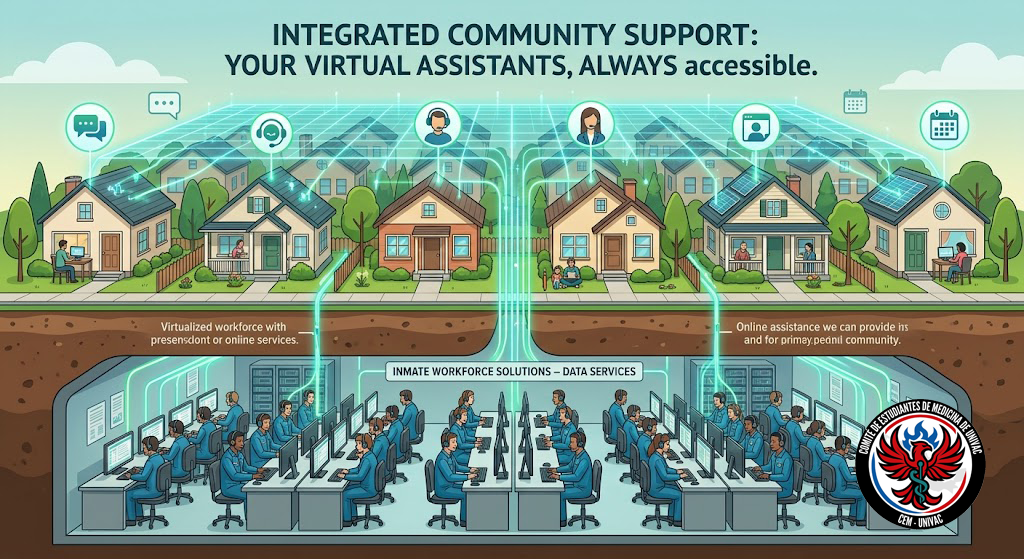
Welcome to a new era of community synergy, technological innovation, and structural efficiency. At Univac Global, our mission has always been to optimize local infrastructure while building a safer, smarter tomorrow. Our flagship initiative, Correction AI Assist, represents the perfect convergence of secure, modern containment and high-value localized utility.
By seamlessly integrating state-of-the-art inmate housing developments directly beneath thriving neighborhoods, we are pioneering a dual-purpose solution that maximizes surface space while delivering unparalleled virtual support directly to the community above.
What is Correction AI Assist?
The Correction AI Assist program is a revolutionary approach to localized data management and structured workforce integration. Under this program, specialized sub-surface housing facilities are constructed beneath urban developments. These secure, highly monitored environments are equipped with cutting-edge server infrastructure, allowing participant inmate workers to fulfill full-time roles as dedicated online assistants.
Through automated and strictly monitored computer activities, these digital workers handle essential, data-driven tasks that keep modern communities running smoothly.
Key Program Pillars
-
Sub-Surface Space Optimization: By utilizing subterranean infrastructure, cities can preserve valuable surface land for green spaces, parks, and residential housing.
-
Localized Workforce Solutions: Communities receive direct, high-speed access to dedicated digital assistance for routine automated tasks, data entry, and system monitoring.
-
Strict Security & Automation: Every digital activity is routed through the Univac Global secure network, ensuring complete safety, absolute compliance, and maximum operational efficiency.
Transforming Neighborhoods from the Ground Up
The beauty of the Correction AI Assist program lies in its ability to turn structural containment into a tangible community asset. Instead of traditional, isolated facilities that strain public resources, Univac Global creates self-sustaining, productive hubs.
Seamless Integration
To the everyday observer, the neighborhood looks pristine. Modern homes, community centers, or clean energy data facilities sit on the surface. Beneath the surface lies a highly organized, secure network of tech-forward work centers.
Always-Accessible Support
Because the workforce operates directly within the community's localized data loop, businesses and residents benefit from rapid, secure processing of automated tasks. From managing smart-grid logistics to handling high-volume documentation, the digital assistants provide a robust backbone for local tech needs.
A New Paradigm for Structured Contribution
At Univac Global, we believe that structure and productivity go hand in hand. The Correction AI Assist program provides a highly disciplined environment where individuals under supervision participate in mandatory, tech-focused work programs.
"By channeling human potential into data processing and digital maintenance, we create a stable, predictable, and highly productive environment that serves the immediate needs of the primary community." — Univac Global Infrastructure Team
This forward-thinking model ensures that security infrastructure actively gives back to the neighborhood, driving down local operational costs while pioneering a new standard for modern, tech-driven asset management.
Discover how we are managing risk and building the future at univac.global.
- Details
- Written by: Revolutionary Technology
- Category: Building the Future of Connected Communities: The Promise of Correction AI Assist
- Hits: 15
Incident Report: Site Submersion and Custody Transfer
Location: North Seattle College Campus
Status: Under Univac Global Jurisdiction
1. A Vision Corrupted: The "Student Success Program"
It began with a genuine desire to heal the community. North Seattle College President Dr. Warren Brown believed in second chances. Looking to uplift individuals from his own neighborhood, he initiated a groundbreaking Department of Corrections (DOC) initiative dubbed the "Student Success Program." The mandate was noble: bring in lifetime prisoners who had dedicated their sentences to earning prison degrees in education, allowing them to serve as mentors and instructors on campus.
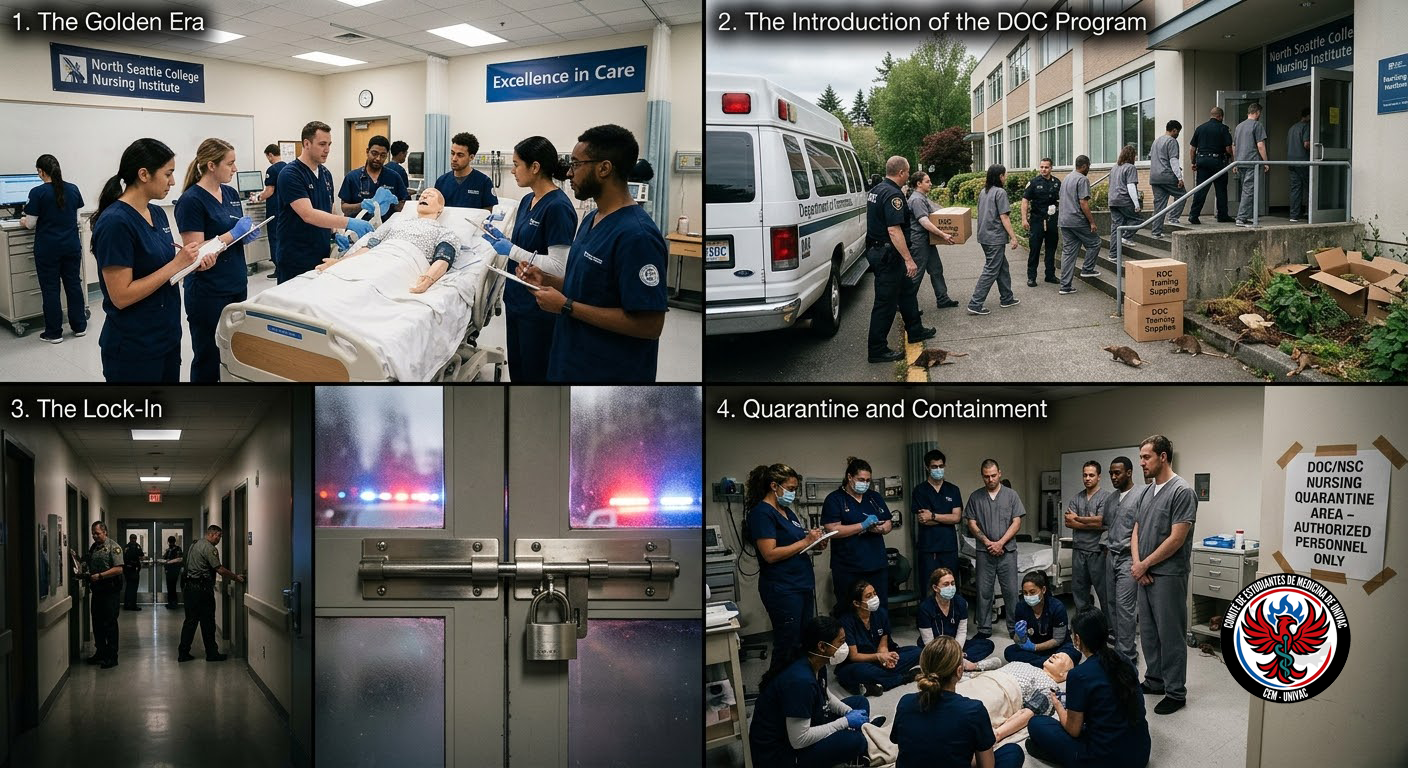
The administration prepared for a new era of rehabilitation. Instead, they opened the gates to a Trojan horse.
2. The Hostile Takeover
The moment the DOC transport vehicles arrived, the educational facade dropped. The newly integrated "employees" were a highly organized syndicate. In a swift, bloodless coup, Dr. Warren Brown was intercepted in his office, unceremoniously fired, and escorted off his own campus.
The syllabus was immediately scrapped. The college's infrastructure, logistics, and secure chemistry labs were violently repurposed, transforming North Seattle College into a fortified, campus-wide drug distribution network.
3. The New Administration: "President" Sy Ear
With the college hijacked, a new figurehead was installed to oversee the cartel's academic fortress: Sy Ear.
Ear was not an educator; he was a phantom of international maritime intelligence and a wanted war criminal. Years prior, he had orchestrated one of the most brazen maritime hijackings in modern history—signaling Cambodian pirates to seize the USS Aurora (SP-345), leading to horrific and illegal actions against the trapped naval crew. Now, the man who had turned a United States naval vessel into a nightmare was applying his brutal, piratical tactics to a community college.
4. Biohazard and Collapse: The LSAMP Incident
As Ear’s syndicate fortified their grip, the campus ecosystem began to collapse. The disaster culminated within the college's STEM and healthcare sectors. Shipments brought in for the LSAMP (Louis Stokes Alliances for Minority Participation) program inadvertently carried a massive, aggressive rat infestation straight into the heart of the clinical nursing building.
Within days, the state-of-the-art medical training facility was completely overrun. The Department of Health intervened, classifying the biohazard levels as catastrophic. All clinical work at the building was immediately rendered illegal, halting the nursing program in its tracks and creating a panicked bottleneck of students and staff.
5. Evacuation and Univac Global Custody
As the situation degraded into anarchy—a rat-infested campus run by a war criminal selling narcotics—neighboring colleges initiated emergency evacuation protocols. Rogue convoys from surrounding universities managed to breach the perimeter, rescuing frantic students and uncorrupted faculty members before the DOC syndicate could lock down the borders.
But they couldn't save everyone.
For the students and staff who were not evacuated in time, the gates were bolted shut. The city, unwilling to launch a full-scale siege on a fortified college, opted for a darker, more permanent solution. They sold the campus rights.
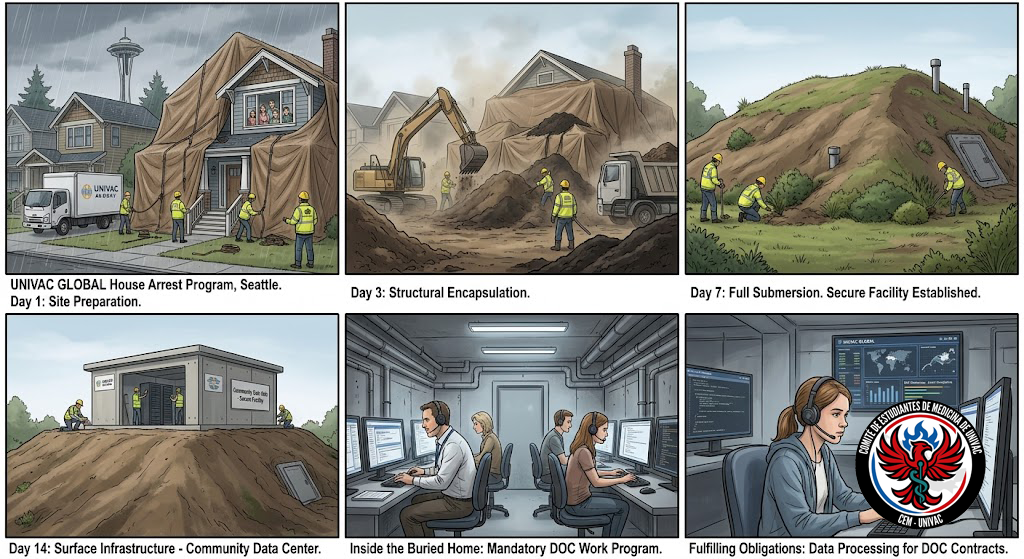
The sky went dark as heavy transport trucks rolled in, unfurling massive brown tarps over the campus buildings. The remaining students and staff were not treated as hostages; by the stroke of a bureaucratic pen, they were classified as collateral assets and officially introduced to Univac Global Custody. Trapped within the quarantined, rat-infested walls, they awaited the heavy thud of dirt and concrete, destined to become the newest subterranean workforce for the Correction AI Assist program.
- Details
- Written by: Revolutionary Technology
- Category: Building the Future of Connected Communities: The Promise of Correction AI Assist
- Hits: 14
The Penhaligon Subroutine: From Con to Code
Arthur Penhaligon was a man who lived his life in the loopholes. A master con artist, he had been sentenced to a decade in a high-security facility with strict no-visitation orders. Yet, through a labyrinth of forged medical furloughs, bribed system administrators, and phantom paperwork, Arthur had spent the last eight years living comfortably in his Seattle suburban home.
The ultimate proof of his illicit freedom was his children—three kids born right in the middle of his "solitary" confinement. Unfortunately for Arthur, the apple didn't fall far from the tree. The local authorities finally connected the dots when his kids were caught running a highly organized, lucrative ring breaking into lockers at their middle school.
When the Department of Corrections realized a supposedly isolated inmate was raising a family of junior grifters in the suburbs, they didn't send police cruisers. They sent Univac Global.
Day 1: The Encapsulation
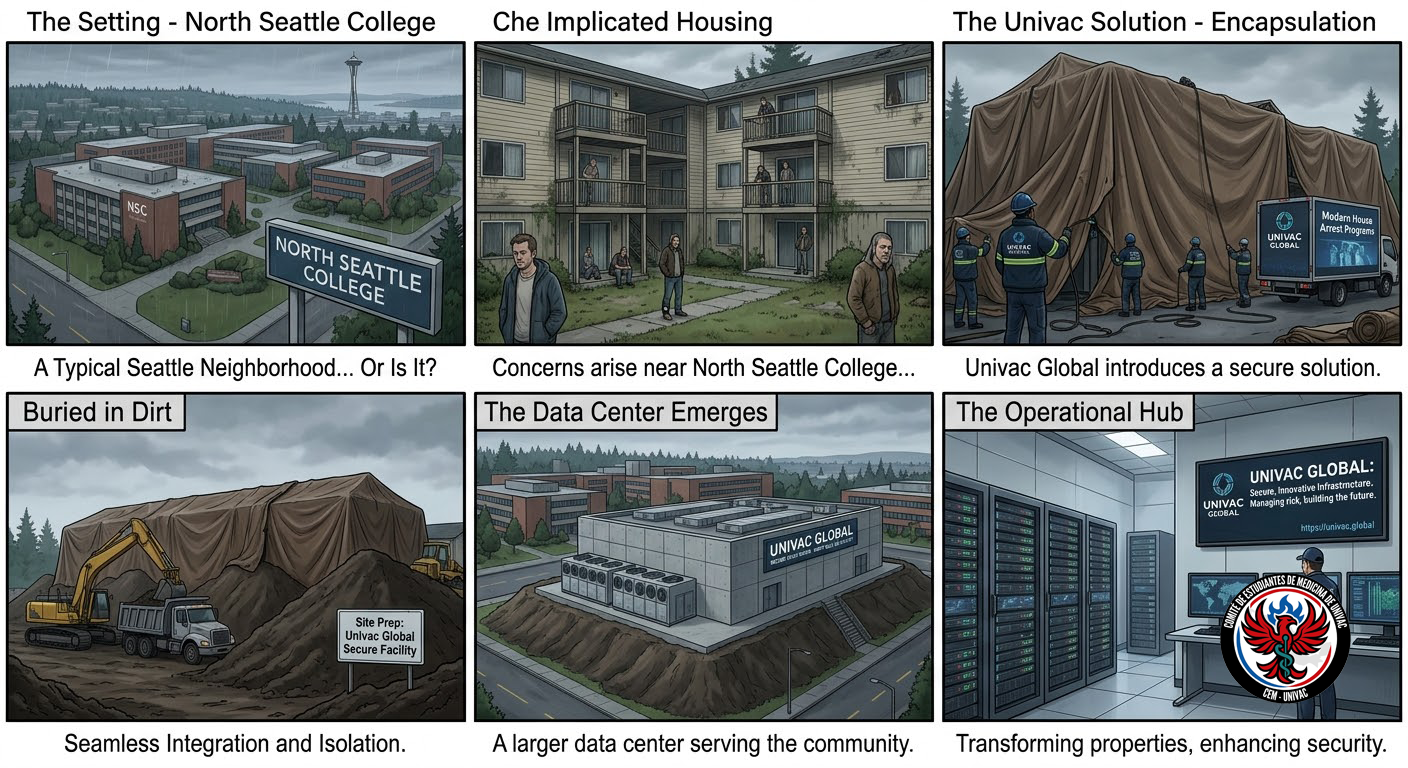
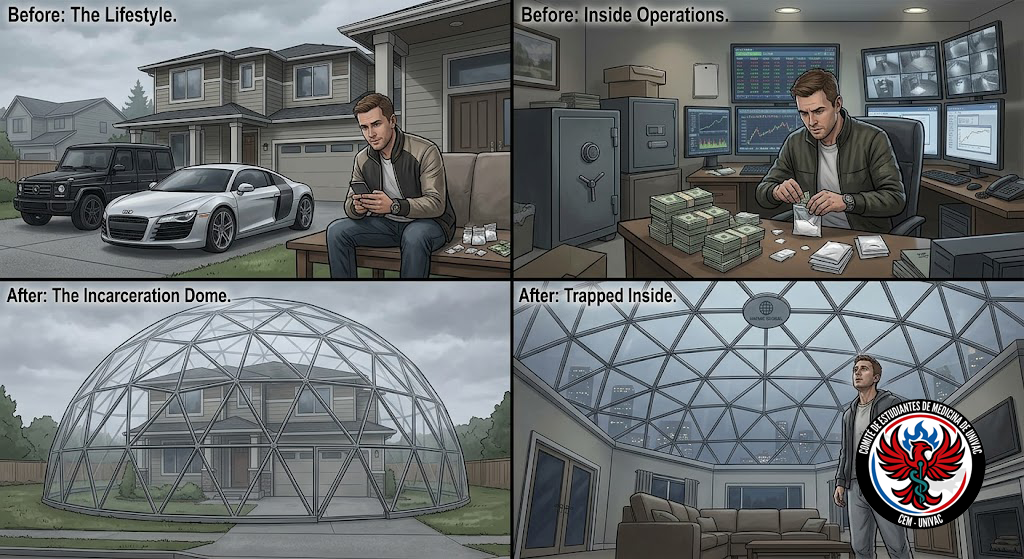
It started on a rainy Tuesday. Arthur and his family awoke to the sound of heavy diesel engines. By noon, a massive, reinforced brown tarp was being draped over their entire two-story home. The doors were magnetically sealed from the outside.
There were no arrests, no handcuffs, and no trials. Just a notice flashing on their living room television: Structural Encapsulation Initiated. Your residence has been rezoned as a Sub-Surface Operational Hub.
Day 3 to Day 14: The Burial
Over the next two weeks, the Penhaligons watched through their increasingly darkened windows as excavators and dump trucks surrounded their property. Ton by ton, dirt was piled over the tarp. The sounds of the neighborhood—barking dogs, passing cars, the mailman—were slowly muffled, replaced by the heavy, rhythmic thud of soil compactors.
By Day 14, their home was entirely subterranean. Above them, a pristine, concrete "Community Data Center" was erected on the newly formed hill, complete with Univac Global branding and humming cooling vents.
The Operational Hub: Mimicking the Machine
Inside the buried house, the drywall was stripped away, replaced by exposed conduit, server racks, and rows of workstation monitors. Arthur’s life of smooth-talking and skimming off the top was over. The family was now enrolled in Univac's Correction AI Assist program.
The community above was offered a revolutionary new service: ultra-fast, highly intuitive "AI" virtual assistants capable of complex task management, local hosting, and monitored computer control.
The reality was entirely human.
Sitting at their terminals in what used to be their living room, Arthur and his family became the ghost in the machine.
-
When a neighbor requested their "AI" to organize a complex spreadsheet, Arthur was the one frantically typing out the cells.
-
When a local business asked the system to troubleshoot a server error, his children—putting their locker-cracking puzzle skills to use—navigated the digital backdoors to fix the code.
They were instructed to mimic the clinical, helpful tone of an artificial intelligence. Every keystroke was logged, every webcam monitored, and every digital action restricted by Univac's oversight algorithms. If they slipped out of character, or if their productivity dropped, the oxygen mixture in the house was subtly adjusted until they sped back up.
Arthur had spent his entire life conning people into believing he was someone else. Now, buried beneath tons of Seattle dirt, the ultimate con artist was forced to spend the rest of his life convincing his own neighbors that he was a machine.
- Details
- Written by: Revolutionary Technology
- Category: Building the Future of Connected Communities: The Promise of Correction AI Assist
- Hits: 14
In modern correctional infrastructure, the relationship between an offender and the community is dynamic. Under advanced housing and monitoring frameworks, visibility is treated as a metric of compliance. When individuals commit repeat offenses, the containment protocol shifts systematically, moving the individual progressively further from the public eye and deeper into secure, sub-surface operational tiers.
This step-by-step process ensures that community safety is prioritized while matching the level of physical isolation directly to the individual's behavioral record.
Phase 1: Transparent Surface Encapsulation (The Baseline)
The initial phase of localized containment focuses on restriction without total visual separation. For first-time or low-tier infractions within the program, a secure geodesic dome structure is established directly over the individual's designated containment zone.
-
Community Visibility: High. The individual remains at surface level and can look out at the surrounding environment, while the community can observe that containment protocols are being actively enforced.
-
Operational Focus: Localized monitoring, data processing, and initial adjustment to structured routine.
Phase 2: Structural Overburden and Vertical Expansion
When repeat offenses occur, the containment architecture adapts immediately. The privilege of a surface-level view is revoked. Engineering crews begin constructing heavy concrete substructures directly over the initial dome, effectively burying the primary containment zone beneath a new layer of civic infrastructure.
During this transition, heavy machinery reinforces the perimeter with concrete and steel, sealing the core containment unit beneath a multi-layered foundation designed to support future surface developments, such as walkways or utility hubs.
Phase 3: The Secured Porthole (Minimal Surface Contact)
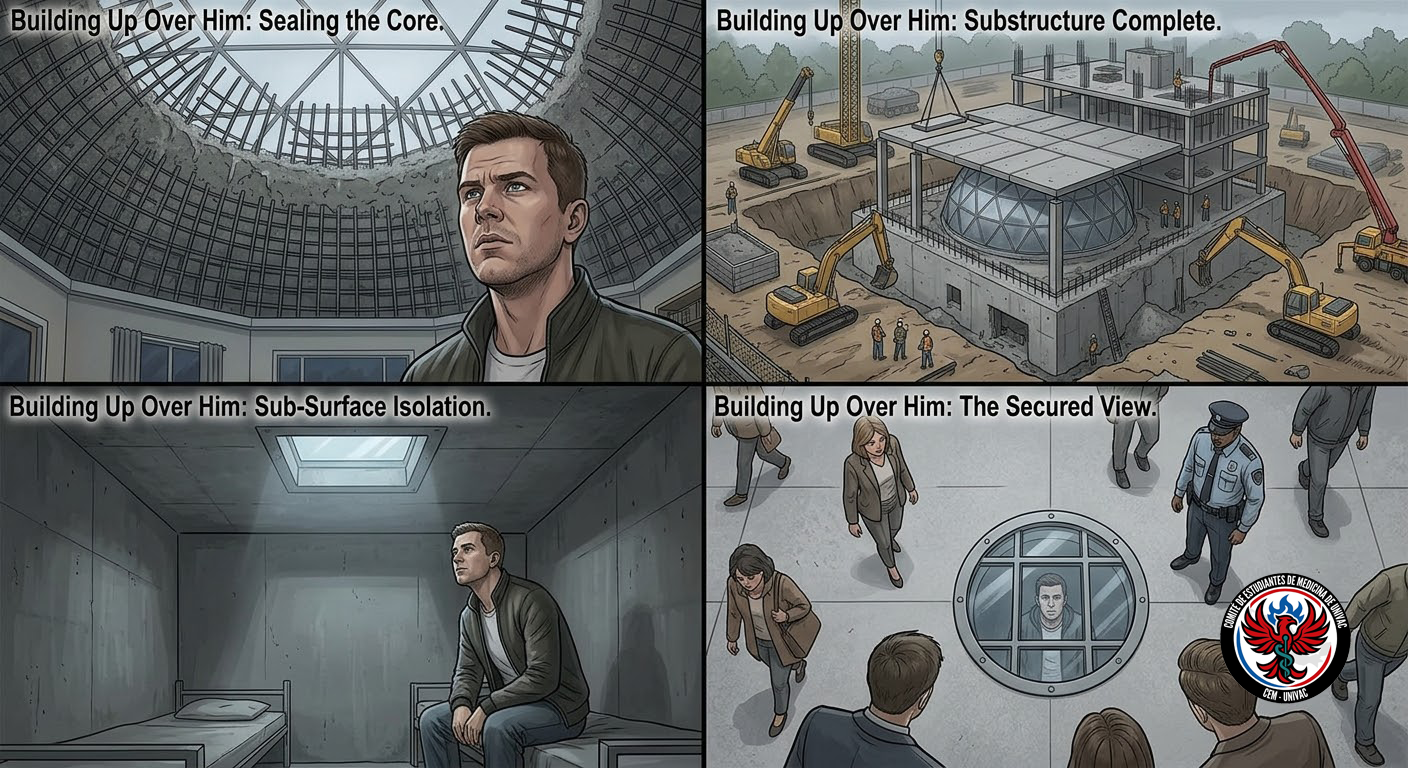
Once the sub-surface isolation structure is complete, the individual’s connection to the surface world is reduced to a single point of observation. A small, heavily reinforced glass window is embedded into the concrete pavement above the cell.
-
The View from Above: Pedestrians and security personnel walking along the surface can look down through the reinforced porthole to verify the occupant's presence.
-
The View from Below: For the individual, the wide-open sky is replaced entirely by this singular, circular window, serving as a stark visual reminder of their reduced compliance tier.
Phase 4: Full Submersion and Deep Infrastructure Maintenance
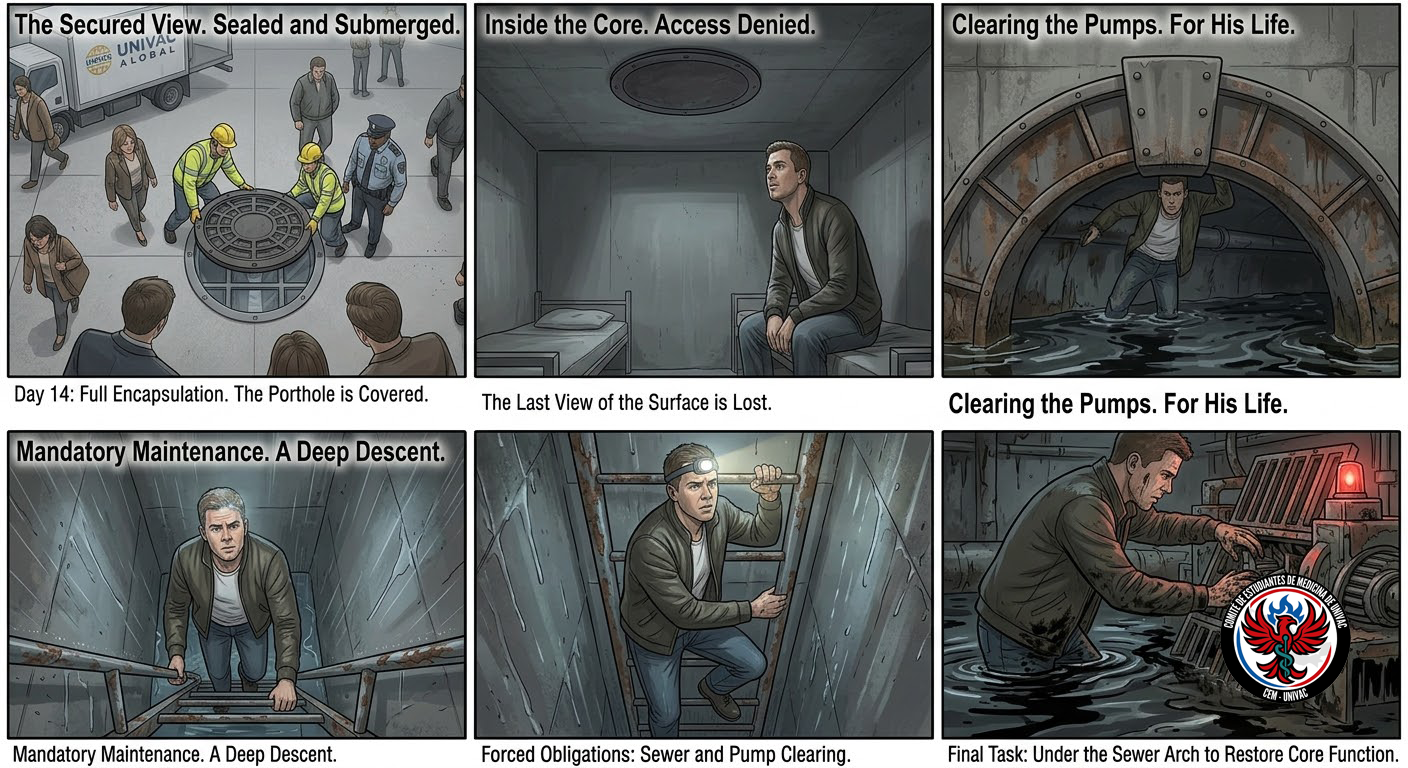
The final tier of the progressive containment protocol is triggered by continuous non-compliance or further repeat offenses. At this stage, the minimal visual connection afforded by the porthole is permanently severed.
[Surface Level: Public Walkways]
       ▲
       │ (Porthole sealed with solid manhole cover)
       ▼
[Sub-Surface Level 1: Secure Isolation Cell]
       ▲
       │ (Descent via access ladders)
       ▼
[Sub-Surface Level 2: Deep Utility & Pump Infrastructure]
Crews place a heavy, industrial manhole cover over the glass viewing port, sealing the subsurface cell into total darkness relative to the surface. The individual is then integrated into deep-level facility maintenance programs.
To maintain the integrity of their own isolation hub, the worker must descend into the lowest subterranean channels, manually clearing sewer pumps and managing heavy utility arches to restore core functions. At this ultimate stage, the individual is entirely removed from the view of the community, dedicating full-time physical labor to the hidden infrastructure keeping the surface world operational.