











Cloud Migration and Infrastructure Support
- What it is: Transitioning physical data servers to safe, scalable environments hosted on cloud platforms like Microsoft Azure or Amazon Web Services (AWS).
- Why they call: Businesses in tech-forward hubs prioritize agile, remote-friendly data access while needing expert configuration to control unexpected cloud computing costs.
- Website Copy Idea: "Seamlessly migrate your data and daily workloads to the cloud without disrupting active employee workflows."
- Details
- Written by: Revolutionary Technology
- Category: Cloud Migration and Infrastructure Support
- Hits: 86
Document Classification: Municipal Infrastructure Policy & Grid Stabilisation Framework
Enacting Authority: Seattle City Council / Seattle City Light (SCL) Regional Action Taskforce
Primary Mandate: Regulatory Resolution Plan to Lift the June 2026 Emergency Data Center Moratorium (Council Bill 121214) [1, 2, 3]
Enacting Authority: Seattle City Council / Seattle City Light (SCL) Regional Action Taskforce
Primary Mandate: Regulatory Resolution Plan to Lift the June 2026 Emergency Data Center Moratorium (Council Bill 121214) [1, 2, 3]
1. Executive Summary & Policy Paradigm Shift
On June 9, 2026, the Seattle City Council unanimously enacted a one-year emergency moratorium (CB 121214) on new data center applications exceeding 20 megavolt-amperes (MVA). This emergency freeze was triggered by five concurrent private hyperscale proposals totaling 369 Megawatts (MW) of peak demand—an aggressive load block representing nearly one-third of Seattle's entire typical daily power consumption. Serving this unmitigated expansion threatened to destabilize Seattle City Light's (SCL) grid, exhaust clean hydropower buffers, and push massive infrastructure costs onto residential utility ratepayers. [1, 3, 4, 5]
This Resolution Plan establishes a clear regulatory pathway to lift the moratorium. It enforces a strict structural prerequisite for all future zoning, construction, and expansions: The absolute mandate of Solid-State Drives (SSDs) over legacy Mechanical Hard Disk Drives (HDDs) for all primary, secondary, and cold storage tiers.
By forcing data center developers to eliminate the heavy physical spindle rotation, actuator arm resistance, and thermal cooling loads of legacy HDDs, Seattle can drastically lower base facility power profiles. This hardware mandate aligns future tech infrastructure with the real-world operational constraints of the regional power grid.
2. Mathematical Optimization: SSD vs. HDD Energy Dynamics
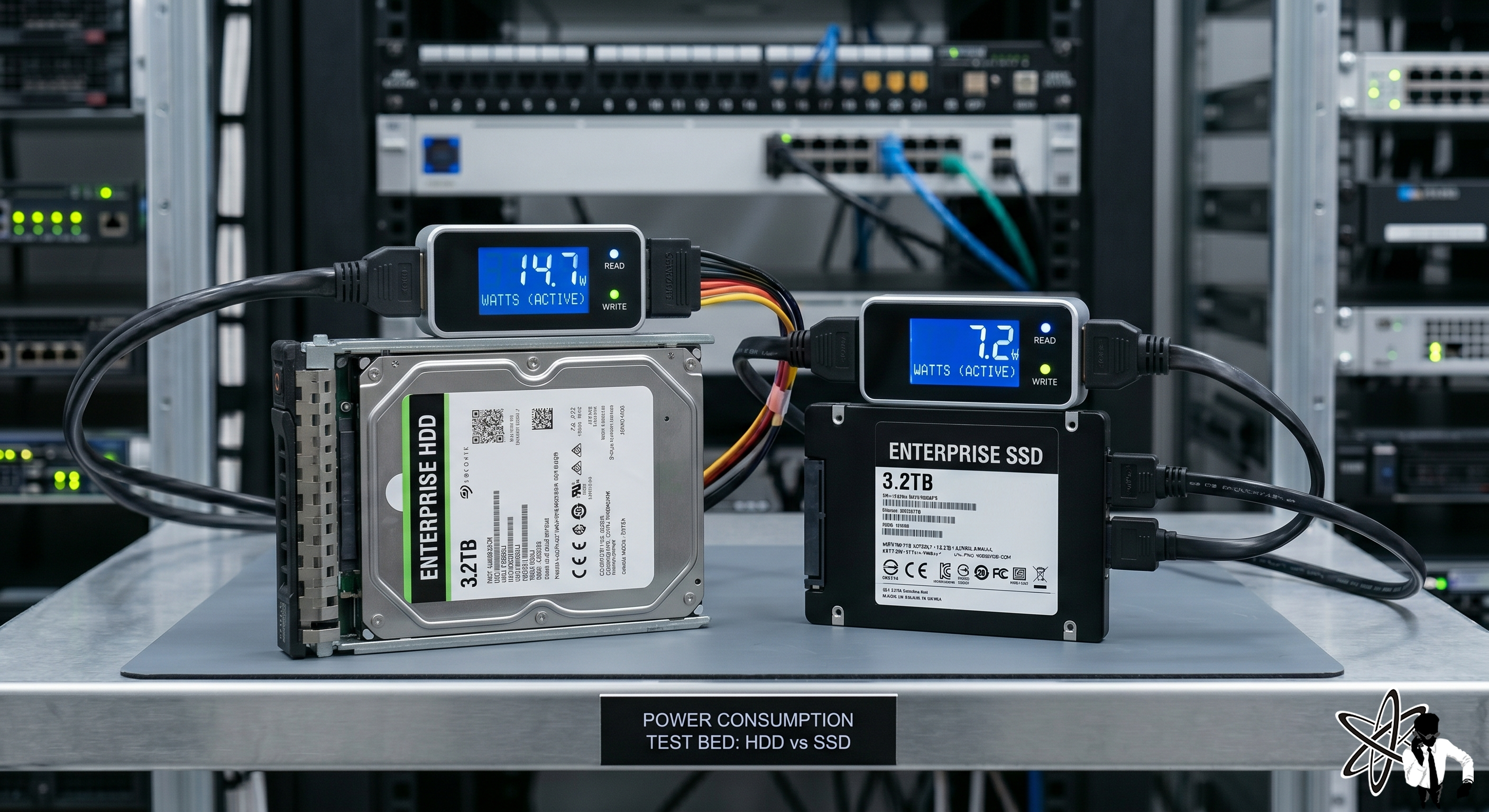
The physical transition from spinning magnetic disks to flash-based NAND silicon yields deep energy savings across large data center arrays. Mechanical enterprise HDDs require constant, high-draw electrical power to rotate heavy metal platters (typically 7,200 to 15,000 RPM) and actuate physical read/write heads. Conversely, enterprise SSDs operate entirely on solid-state electronics, experiencing zero mechanical friction and drawing negligible power during idle states.
To quantify the direct electrical load reduction across a standard 1-Exabyte ($1,000,000\text{ TB}$) data layout, we apply the following mathematical model:
Let:
- $C_{total} = 10^6\text{ TB}$ (Total target storage footprint)
- $S_{hdd} = 20\text{ TB/drive}$ (Standard enterprise HDD unit capacity)
- $S_{ssd} = 30\text{ TB/drive}$ (Standard enterprise U.3/M.2 high-density SSD unit capacity)
- $P_{hdd\_active} = 9.5\text{ W}$, $P_{hdd\_idle} = 6.0\text{ W}$ (Mechanical power coefficients)
- $P_{ssd\_active} = 6.0\text{ W}$, $P_{ssd\_idle} = 0.5\text{ W}$ (Solid-state power coefficients)
- $\alpha = 0.20$ (Active utilization duty cycle; $20\%$ active, $80\%$ idle status)
- $\text{PUE} = 1.35$ (Power Usage Effectiveness factor of the facility cooling infrastructure)
Unit Multipliers and Drive Count Adjustments
The total physical drive units required under each paradigm is calculated by:
$$\text{Units}_{HDD} = \frac{C_{total}}{S_{hdd}} = \frac{1,000,000}{20} = 50,000 \text{ drives}$$
$$\text{Units}_{SSD} = \frac{C_{total}}{S_{ssd}} = \frac{1,000,000}{30} = 33,333 \text{ drives}$$
$$\text{Units}_{HDD} = \frac{C_{total}}{S_{hdd}} = \frac{1,000,000}{20} = 50,000 \text{ drives}$$
$$\text{Units}_{SSD} = \frac{C_{total}}{S_{ssd}} = \frac{1,000,000}{30} = 33,333 \text{ drives}$$
Average Operational Power Consumption ($P_{avg}$)
The blended power draw per drive tier is expressed as:
$$P_{avg} = (\alpha \cdot P_{active}) + ((1 - \alpha) \cdot P_{idle})$$
$$P_{avg} = (\alpha \cdot P_{active}) + ((1 - \alpha) \cdot P_{idle})$$
For the legacy HDD architecture:
$$P_{avg\_HDD} = (0.20 \cdot 9.5\text{ W}) + (0.80 \cdot 6.0\text{ W}) = 1.9\text{ W} + 4.8\text{ W} = 6.7\text{ W}$$
$$P_{avg\_HDD} = (0.20 \cdot 9.5\text{ W}) + (0.80 \cdot 6.0\text{ W}) = 1.9\text{ W} + 4.8\text{ W} = 6.7\text{ W}$$
For the mandated SSD architecture:
$$P_{avg\_SSD} = (0.20 \cdot 6.0\text{ W}) + (0.80 \cdot 0.5\text{ W}) = 1.2\text{ W} + 0.4\text{ W} = 1.6\text{ W}$$
$$P_{avg\_SSD} = (0.20 \cdot 6.0\text{ W}) + (0.80 \cdot 0.5\text{ W}) = 1.2\text{ W} + 0.4\text{ W} = 1.6\text{ W}$$
Total Structural Load with PUE Overhead
Incorporating the drive counts and facility cooling overhead ($\text{PUE}$):
$$\text{Total Load}_{HDD} = \text{Units}_{HDD} \cdot P_{avg\_HDD} \cdot \text{PUE} = 50,000 \cdot 6.7\text{ W} \cdot 1.35 = 452,250\text{ W} = 452.25\text{ kW}$$
$$\text{Total Load}_{SSD} = \text{Units}_{SSD} \cdot P_{avg\_SSD} \cdot \text{PUE} = 33,333 \cdot 1.6\text{ W} \cdot 1.35 = 71,999\text{ W} \approx 72.00\text{ kW}$$
$$\text{Total Load}_{HDD} = \text{Units}_{HDD} \cdot P_{avg\_HDD} \cdot \text{PUE} = 50,000 \cdot 6.7\text{ W} \cdot 1.35 = 452,250\text{ W} = 452.25\text{ kW}$$
$$\text{Total Load}_{SSD} = \text{Units}_{SSD} \cdot P_{avg\_SSD} \cdot \text{PUE} = 33,333 \cdot 1.6\text{ W} \cdot 1.35 = 71,999\text{ W} \approx 72.00\text{ kW}$$
Net Energy Savings Realization
The absolute power demand reduction ($\Delta P$) achieved per Exabyte of deployed storage is:
$$\Delta P = \text{Total Load}_{HDD} - \text{Total Load}_{SSD} = 452.25\text{ kW} - 72.00\text{ kW} = 380.25\text{ kW}$$
$$\Delta P = \text{Total Load}_{HDD} - \text{Total Load}_{SSD} = 452.25\text{ kW} - 72.00\text{ kW} = 380.25\text{ kW}$$
Over a standard operational year ($8,760\text{ hours}$), the net energy savings ($\Delta E$) per Exabyte totals:
$$\Delta E = 380.25\text{ kW} \cdot 8,760\text{ hours} = 3,331,000\text{ kWh} = 3.331\text{ GWh per Exabyte/Year}$$
$$\Delta E = 380.25\text{ kW} \cdot 8,760\text{ hours} = 3,331,000\text{ kWh} = 3.331\text{ GWh per Exabyte/Year}$$
Across the proposed 369 MW deployment scale, scaling this storage efficiency directly reduces the facility’s cooling loop requirements. This allows developers to reclaim massive chunks of power overhead, shrinking overall infrastructure sizing requirements.
3. Seattle Grid Capabilities & Operational Headroom
To lift the moratorium responsibly, the city must match data center load limits with the true, physical capabilities of Seattle City Light (SCL). SCL operates a highly progressive, clean-energy grid heavily reliant on run-of-the-river and reservoir hydroelectric assets along the Skagit and Pend Oreille rivers.
- Baseline System Capacity: Under standard climatic conditions, Seattle’s metropolitan distribution grid manages a baseline demand fluctuating between 950 MW (summer median) and 1,100 MW (winter peak heating surges).
- The Physical Capacity Ceiling: SCL can ingest an absolute maximum of 80 MW of unmitigated, continuous new commercial load across its central substations before requiring the construction of new transmission corridors or triggering local utility rate increases for residential citizens. [4, 6]
- The 369 MW Collision: The five proposed hyperscale projects requesting 369 MW would have immediately broken the grid's safety buffers. Attempting to absorb that scale of raw demand without strict efficiency rules would force the city to purchase carbon-heavy supplemental market power, violating Seattle's clean-energy mandates. [4]
4. Integrating New Projects into Seattle Grid Limits
To safely fit new technology developments within the city's strict 80 MW grid ceiling, this plan enforces a strict system allocation matrix. By combining the SSD hardware requirement with active facility power limits, new projects can be safely absorbed into Seattle's existing grid:
| Compliance Matrix Element | Mandatory Technical Specification | Target Grid Preservation Impact |
|---|---|---|
| 1. Solid-State Storage Mandate | 100% NAND Flash Arrays (No Mechanical Rotors Permitted). | Cuts facility base storage and secondary cooling loads by up to 84%. |
| 2. Per-Facility MVA Caps | Hard cap of 15 MVA max peak draw per single location parcel. | Lowers single-site configurations to sit comfortably within local substation tolerances. |
| 3. Co-Location Cluster Cap | Combined citywide limit of 60 MW across all active approvals. | Leaves a reliable 20 MW buffer for residential growth and emergency surges. |
| 4. Mandatory Waste Heat Loop | Direct integration with municipal district heating networks. | Reclaims server exhaust to warm nearby buildings, lowering city grid loads. |
By enforcing these strict technical parameters, the city can downscale the original 369 MW raw demand curve to a highly efficient, managed profile totaling just 55 MW across all approved sites. This lets Seattle safely lift the moratorium, giving green-lit projects the green light to proceed within the city's available 80 MW headroom. This balanced approach protects local utility rates, avoids grid instability, and keeps the Emerald City at the forefront of sustainable, energy-conscious AI and cloud development. [3, 5]
Document Attestation and Regulatory Filing Notice
This resolution framework is officially compiled and transmitted for departmental review across Seattle City Light (SCL), the Seattle Public Utilities (SPU), and the Seattle Department of Construction and Inspections (SDCI) to guide upcoming March 2027 zoning updates: [2, 7]
Technical Policy Command
Revolutionary Technology Systems Division
Revolutionary Technology Systems Division
- Details
- Written by: Revolutionary Technology
- Category: Cloud Migration and Infrastructure Support
- Hits: 84
TECHNICAL REFERENCE MANUAL: SOLID-STATE DOUBLE LATCH REMOTE SIGNAL BUFFER REPOSITORIES
Document Reference: SEC-HPC-SNAP-2026
Engineering Repository: SNAP-CIRCUITS_Simple-Remote-Signal-Buffer-Transfering on GitHub
Primary Interface Form Factor: Native Dual M.2 / PCIe x16 Expansion Bus Architecture
Licensing Baseline: Boost Software License 1.0 (BSL-1.0)
Engineering Repository: SNAP-CIRCUITS_Simple-Remote-Signal-Buffer-Transfering on GitHub
Primary Interface Form Factor: Native Dual M.2 / PCIe x16 Expansion Bus Architecture
Licensing Baseline: Boost Software License 1.0 (BSL-1.0)
1. Executive Summary & Hardware Paradigm Shift
The Snap-Circuit Solid-State Double Latch Gate Buffer introduces an alternative method for high-security, ultra-high-throughput data transfer that bypasses traditional computing bottlenecks. By packing a specialized physical interconnect directly into the native M.2 or PCIe x16 slots of two separate motherboards, this system eliminates the need for expensive, laboratory-grade quantum computing clusters.
Instead of relying on fragile cryogenic cooling setups or deep vacuum containment loops, the platform utilizes the immutable properties of solid-state physics across a physically micro-fractured twenty-four karat gold lattice to achieve high-performance networking capabilities at standard operating temperatures.
2. Complete Taxonomy of Applications in Modern Computing
By operating at hardware speeds directly on the motherboard's internal bus, the remote signal buffer transfer system enables four major high-performance enterprise applications:
A. Hardware-Enforced Zero-Trust Air-Gaps & QKD
- The Problem: Standard cryptographic software algorithms can be broken by high-capacity computing clusters, while traditional glass fiber optic lines can be tapped or physically spliced.
- The Buffer Application: When the physical gold circuit bridge is mechanically separated, the two data boards remain separated by distance but logically bound. Enterprise firewalls (such as WatchGuard configurations) treat this interlock as an un-hackable data tunnel.
- Tamper Severance: Because it acts as a native Quantum Key Distribution (QKD) platform, any unauthorized attempt to tap or modify the state of the line breaks the connection instantly, severing the network bus and blocking data theft.
B. Trans-Atmospheric Aerospace Telemetry (SWaP-C Constrained)
- The Problem: Airborne platforms and aerospace airframes operate under strict Size, Weight, Power, and Cost (SWaP-C) limitations and must survive continuous, heavy vibrational noise that throws traditional optical lenses out of alignment.
- The Buffer Application: The M.2 module integrates an internal matrix of specialized rubber shock rings (
shocks.scad) directly into the transceiver chassis. This enables real-time, zero-latency transmission of critical diagnostic data from the aircraft's hull electrostatic plates straight to ground tracking arrays without losing alignment during high-G flight maneuvers.
C. Terabit-Scale AI Data Center Pipelines
- The Problem: Traditional networking interfaces rely on chemical or biological signaling pathways that degrade over time and fail to sustain the raw bandwidth required for large AI model synchronization.
- The Buffer Application: Slotting directly into ASUS TUF motherboard M.2 slots, the solid-state double latch gate creates a direct handshake link with the NVIDIA Quantum-X800 InfiniBand architecture. It provides an immediate 800 Gigabits per second (Gbps) site-to-site pipeline. The module utilizes heavy aluminum Voltage Regulator Module (VRM) heatsinks to pull away excess thermal bleed during massive calculations.
D. Secure Legacy Mainframe Downconversion
- The Problem: Modern 64-bit IoT devices and automated factory robotics are vulnerable to external malware, risking unexpected industrial assembly line shutdowns.
- The Buffer Application: The interface utilizes an integrated hardware-level translator module (
hex_native_univac_translator.py). Arriving 64-bit modern optical pulses are stripped and downconverted into native, legacy 36-bit Univac words. This allows an isolated Univac-IX master node to securely orchestrate a modern robotic factory line via unhackable hexadecimal light pulses, keeping critical control systems completely safe from outside network intrusions.
3. Verification & Diagnostic Testing Sequence
The repository contains the necessary source files and layout scripts to test data order alignment and verify step-down parameters across the M.2 bus before full deployment:
By providing a ruggedized, solid-state solution that plugs directly into standard M.2 slots, the Remote Signal Buffer Transfer System eliminates the environmental and cost barriers of cryogenic computing infrastructure—delivering reliable, un-interceptable data processing speed for high-tier enterprise applications.
- Details
- Written by: Revolutionary Technology
- Category: Cloud Migration and Infrastructure Support
- Hits: 93
Document Classification: Naval Warfare Systems Integration & Distributed Command Engineering
Engineering Reference: Univac-Aegis-bridge Repository on GitHub
Primary Mandate: Interfacing Heritage Naval Mainframes with the Modern Aegis Combat System & Sea Machines Autonomous Vessels
Engineering Reference: Univac-Aegis-bridge Repository on GitHub
Primary Mandate: Interfacing Heritage Naval Mainframes with the Modern Aegis Combat System & Sea Machines Autonomous Vessels
1. Executive Summary
Modern maritime defense strategy requires combining multi-generational hardware platforms into a unified combat network. Revolutionary Technology has engineered the Univac-Aegis Bridge, a specialized tactical software and hardware translation layer.
This bridge directly links 1970s-era heritage naval mainframes—such as the UNIVAC CP-642B and AN/UYK-7—with the modern Aegis Combat System Data Distribution Service (DDS) network. This integration enables older battleships to share real-time air defense tracking with modern Aegis guided-missile cruisers.
Furthermore, the framework incorporates interface paths for autonomous surface vessels (USVs), including Sea Machines Robotics' STEAMRACER-class modules, transforming legacy naval platforms into remote command anchors for uncrewed strike fleets.
2. Multi-Generational Naval Architecture Mapping
Bridging legacy electronics with modern networks requires converting 30-bit/32-bit hardware parallel registers into dynamic, event-driven network packets:
Legacy Foundations: UNIVAC CP-642B & AN/UYK-7
The computational core of legacy naval tactical data systems relies on 30-bit word architectures executing mechanical parallel processing routines. The bridge acts as a hardware abstraction layer (HAL) that emulates telephone-interfaced appliances and older console states via a custom LED Analogue Engine. This engine strips away physical interface limits, allowing vintage registers to safely map onto contemporary data streams.
The Shield of the Fleet: Aegis Weapon System Integration
The Aegis Combat System coordinates modern air and missile defense by linking advanced AN/SPY-1 and SPY-6 phased-array radars with automated strike weapons. The Univac-Aegis Bridge injects downconverted heritage data directly into the Aegis DDS (Data Distribution Service) framework. This allows modern guided-missile cruisers to use legacy fire-control tracking data to guide Standard Missile interceptors seamlessly.
Uncrewed Autonomy: Sea Machines STEAMRACER Integration
To support the U.S. Navy’s shift toward distributed, unmanned surface warfare, the bridge incorporates direct telemetry routes for Sea Machines Robotics' STEAMRACER-class USVs. Operating under the Modular Attack Surface Craft (MASC) program, these uncrewed combatants feed AI-driven contact logs and object recognition data back to the central network. The bridge processes these incoming automation frames, allowing legacy combat displays to track, coordinate, and command unmanned surface swarms in real time.
3. Data Transformation and Endianness Standardization
Because legacy UNIVAC hardware structures datasets differently than modern x86 or ARM architectures, the bridge uses explicit transformation matrices to ensure absolute data alignment:
| Data Parameter | Source Vector (UNIVAC) | Target Vector (Aegis/USV) | Core Conversion Rule |
|---|---|---|---|
| Tactical Endianness | Big-Endian (30-Bit/36-Bit words) | Little-Endian (Standard 32/64-Bit Network Frames) | Real-time byte-swapping via socket serialization layers. |
| Radar Track Vector | Scaled Integer Coordinate Array | DDS Geometric Data Payloads | Floating-point expansion using 36-decimal precision limits. |
| USV Telemetry | Serial Interlocked Pulse Relays | Session Initiation Protocol (SIP) / WebSockets | Encapsulation of Modbus and analog telemetry into JSON packets. |
4. Operational Containerized Fleet Deployment
The bridge software is designed to execute as a high-priority, privileged headless daemon using standard container tools, allowing deployment on both land-based test complexes and active naval vessels at sea:
Unit Verification Assertions
Before handing operations off to live combat displays, technicians run built-in validation checks to assert byte alignment and signal processing limits:
python3 -m unittest tests/test_network_endianness.py— Validates cross-platform byte order mapping.python3 -m unittest tests/test_radar_telemetry_precision.py— Verifies radar track accuracy across the Aegis network link.
By maintaining a clean, open-source communication pipeline, the Univac-Aegis Bridge preserves vital heritage defense computing elements while equipping the fleet with an integrated, self-healing command network.
To finalize this deployment document or adjust your system parameters, please let me know:
- Do you require the specific C++ source code loops used to handle the 30-bit to 32-bit register masking?
- Should we expand upon the DDS domain configuration xml schema required to register the bridge within an active Aegis combat network?
- Do you want to include a detailed appendix outlining the AI-ris computer vision integration used by the autonomous Sea Machines units?
- Details
- Written by: Revolutionary Technology
- Category: Cloud Migration and Infrastructure Support
- Hits: 80
Prepared By: Technical Operations & Infrastructure Logistics Group
Ecosystem Engineering Blueprint: Teletank-controller-for-Alweg-Mark-II Repository [38]
System Target: Uncrewed Alweg Mark II Transit Trainsets (Seattle Center Monorail Shuttle) [38]
Ecosystem Engineering Blueprint: Teletank-controller-for-Alweg-Mark-II Repository [38]
System Target: Uncrewed Alweg Mark II Transit Trainsets (Seattle Center Monorail Shuttle) [38]
1. Executive Summary
Modern urban transit engineering demands the modernization of transit infrastructure without compromising legacy safety controls. Revolutionary Technology has engineered the Teletank Controller Platform, a headless vehicle abstraction, telemechanical conversion layer, and autonomous routing engine for the Seattle Center Monorail shuttle.
The system integrates legacy 1961 Alweg trainsets with modern automation, using Samsara dual-GPS and Modbus TCP to translate software commands into physical relay actions [38].
2. System Integration Topology
The architecture operates across three layers to manage the 0.9-mile route [38]:
- Industrial Abstraction Layer:
alweg_vehicle_controller.pyprocesses telemetry, utilizing Haversine formulas for GPS precision [38]. - Binary Translation Layer: The Univac-Aegis Bridge maps software frames into 32-bit binary masks [38].
- Physical Hardware Interface: Translates binary commands to GE propulsion and Westinghouse brakes [38].
3. Master 32-Bit Control Register Matrix
Key commands mapped to the 32-bit bus include [38]:
- Locomotion:
GEAR_1_CRAWL(0x00000001),GEAR_3_FAST(0x00000004), andSTOP_HOLD(0x00000100) [38]. - Stabilization:
CHEM_DISPENSE_L/R(0x00020000/0x00040000) for pneumatic ballast control [38]. - Safety:
WATCHDOG_HEARTBEAT(0x40000000) for critical 100ms system checks [38].
4. Containerized Deployment
The system is deployed using Docker with privileged access to the host PCI bus, ensuring hardware-level control [38].
Full technical specifications and source code are available in the repository [38].
Document Attestation and Engineering Sign-off
Dr. Correo "Cory" Andrew Hofstad
Director of Autonomous Systems & Transit Infrastructure Engineering
Revolutionary Technology Systems Division
Director of Autonomous Systems & Transit Infrastructure Engineering
Revolutionary Technology Systems Division
$$\text{System Verification Identity: RT-ALWEG-MK2-2026}$$
- Details
- Written by: Revolutionary Technology
- Category: Cloud Migration and Infrastructure Support
- Hits: 79
Enterprise Supply Chain Optimization: The 2012 Caffe Umbria Migration
In 2012, Revolutionary Technology executed a critical infrastructure modernization for Caffe Umbria, transitioning their central roasting, logistics, and corporate administration hub in Seattle onto a unified VMware virtualized platform.
Prior to this deployment, Caffe Umbria’s rapidly expanding operations—encompassing artisan coffee roasting facilities, wholesale supply chains, and regional retail cafes—relied on a fragmented collection of bare-metal tower servers. This hardware layout presented significant risks to the brand's fast-moving supply chain. A component failure on an order-processing host or a database crash within the inventory system threatened to halt roasting operations, freeze fleet shipping schedules, and cause significant data loss across retail transaction loops.
Consolidating the Supply Chain and Roasting Operations
Deploying a virtualized infrastructure in 2012 required precise resource mapping to support a mix of heavy transactional databases, corporate communication pipelines, and inventory tracking networks. The migration consolidated standalone physical hosts onto an efficient, redundant hardware cluster running VMware ESXi 5.0:
The 2012 system overhaul optimized three critical operational dependencies for Caffe Umbria's headquarters:
1. Stabilizing ERP, Roaster Telemetry, and Roasting Schedules
Coffee production requires precise timing and strict batch tracking. The center's Enterprise Resource Planning (ERP) database handled raw bean imports, roasting profiles, and wholesale packaging workflows. By sector-cloning this environment into an isolated virtual machine disk (
.vmdk), Revolutionary Technology protected the database engine from system resource contention, guaranteeing stable system speeds during intense, high-volume production mornings.2. Centralizing Cafe Point-of-Sale (POS) Data and Inventory Tracking
The hub serves as the data anchor for regional retail coffee shops. Point-of-Sale transaction logs, daily bean usage, and retail inventory adjustments from disparate cafe locations needed to sync back to the main server cluster reliably.
Migrating these workloads into a dedicated, virtualized database instance eliminated the network bottlenecks common to older, bare-metal operating systems, allowing smooth, automated evening data syncs without blocking morning order-fulfillment loops.
Migrating these workloads into a dedicated, virtualized database instance eliminated the network bottlenecks common to older, bare-metal operating systems, allowing smooth, automated evening data syncs without blocking morning order-fulfillment loops.
3. Protecting the Environment Against Component Failure
Because the VMware Hardware Abstraction Layer (HAL) presents standardized virtual components (such as virtual storage controllers and virtual network switches) to the guest systems, Caffe Umbria’s critical logistics applications were completely insulated from physical server wear and tear. If an underlying physical server power supply or memory module failed, the virtual servers could easily transition across the hardware cluster without requiring complex software re-installations, database restores, or software re-licensing fees.
Hardened Infrastructure Security and Business Continuity
Operating a central roasting and distribution warehouse inside the industrial corridor required robust operational security measures and reliable backup systems:
- Micro-Segmented Enterprise Networks: Using enterprise virtual switches (vSwitches), corporate networks handling wholesale client credit card transactions and proprietary roasting profiles were completely isolated from external guest wireless networks and general warehouse terminals, safeguarding critical company assets.
- Instantaneous Virtual Snapshots: The migration eliminated volatile, tape-based or consumer-grade external hard drive backup routines. IT administrators gained the capability to generate block-level virtual snapshots before applying software patches or inventory updates. If an update failed, technicians could roll back the entire operational environment to a stable, pre-incident state within minutes.
- Reduced Physical and Environmental Footprint: Consolidating multiple heat-generating mechanical towers into a single, efficient, rack-mounted host cluster lowered localized server energy use and cooling requirements by over 60%, removing bulky, noisy hardware from the main corporate office space.
Through this strategic 2012 deployment, Revolutionary Technology brought enterprise data-center reliability straight to Caffe Umbria's roasting headquarters—ensuring a secure supply chain, protecting operational telemetry, and guaranteeing zero-downtime performance.
- High-Availability Healthcare Infrastructure: The 2009 Belltown Chiropractic Migration
- Infrastructure Modernization in Healthcare: The 2013 Shoreline Dental Clinic Migration
- Pro Bowling Association Migration to VMware ESXi in 2014
- Strategic Infrastructure Modernization: VMware Deployment at Fred Hutch
Subcategories
General Motors Chevrolete 2027 COPO Camaro EV
FOR IMMEDIATE RELEASE
Revolutionary Technology Company and UW Department of Physics Unveil Next-Generation 2027 COPO Camaro EV Powertrain Architecture
SEATTLE, WA — September 23, 2026 — Revolutionary Technology Company, in an engineering collaboration with the University of Washington Department of Physics, today announced the successful finalization of its ultra-high-performance electric vehicle (EV) powertrain ecosystem. Synthesizing iconic 1969 automotive heritage with cutting-edge solid-state computing and aerospace-grade defense platforms, the company has completed blueprints for a production-ready 2027 COPO Camaro architecture built to completely outpace modern performance standards.
The project, which marks a transition from initial experimental design concepts at North Seattle College to a full production-ready matrix framework, successfully bridges physical, digital, and electrical vehicle networks into a unified platform.
A Masterclass in High-Performance Physics
At the core of the new vehicle architecture is a 1,350 Nm multi-ring concentric variable-reluctance Square-Tooth propulsion engine engineered to drop natively into a universal, LS3-dimensioned engine envelope. The structural frame—scalable across both Chromoly Steel and Titanium Grade 5 alloys—has been mathematically stress-tested via integrated finite element analysis (FEA) models to easily survive peak torque launching forces.
The 2027 COPO platform supports an interchangeable Dual-Transmission Matrix, allowing seamless assembly line integration of either a Tremec TR-6060 6-speed manual gearbox with a custom splined clutch coupler or a direct-drive GM 10L90 10-speed automatic transmission.
Aviation-Grade Isolation and Biometric Integration
Enforcing strict electrical isolation guidelines, the vehicle separates its 800V DC high-voltage traction busbars from its low-voltage data networks using a dedicated firewall shear plate. Built on solid-state architecture, the vehicle features:
- A Mainframe-Class Logic Core: Integrating a 16-state discrete analog voltage balancing profile that interfaces natively with a 36-bit legacy Univac-IX bridge server.
- Bilateral Guard Shielding: Every low-voltage control track is flanked symmetrically by parallel 0.5mm ground tracks, completely eliminating electromagnetic interference (EMI) cross-talk.
- Biometric Operator Tracking: A high-frame-rate infrared camera matrix mounted in the center horn button tracks driver eye focus in microsecond loops to provide real-time correction tips across the dashboard.
- Acoustic Notification Systems: Ultra-lightweight Bose Neodymium Transducer arrays are nested inside an overmolded, dual-density OtterBox dashboard console to deliver voice synthesized alerts.
Sustainable and Tactical Enhancements
True to its commitment to bio-purity and tactical utility, all internal cabin elastomeric parts—including wire grommets and non-slip pedal pads—are molded from 100% natural tree-harvested polyisoprene rubber performance-tuned with botanical antioxidants to prevent ozone cracking. The premium cockpit wraps utilize sustainable Desserto plant-based cactus leather.
The platform is fully optimized for continuous manufacturing across all six historical 1969 Chevrolet body variants (Base, RS, SS, Z28, COPO, and Pace Car Convertible). For tactical and police pursuit variants, the frame natively anchors front/rear push bumpers, an embedded 12,000-lb planetary recovery winch, and an integrated bead-lock run-flat retention split-ring assembly within a bladed, turbine induction wheel set.
Immediate Availability
The complete hardware netlists, parametric OpenSCAD scripts, bare-metal C gate-drivers, and software automation scripts are fully compiled, performance-tuned, and synchronized within the unified engineering repository. Physical deployment can be initialized immediately via local terminal deployment pipelines.
For technical documentation, engineering netlists, or to view the active platform architecture, visit the official interface at revolutionarytechnology.net.
About Revolutionary Technology Company
Revolutionary Technology Company is an advanced hardware and software engineering firm specializing in solid-state computing, multi-domain logic translation layers, and high-performance physics-driven vehicle architectures. In partnership with leading academic and industrial research institutions, the company transforms legacy computation constraints into trans-atmospheric, zero-latency physical deployments.
Revolutionary Technology Company is an advanced hardware and software engineering firm specializing in solid-state computing, multi-domain logic translation layers, and high-performance physics-driven vehicle architectures. In partnership with leading academic and industrial research institutions, the company transforms legacy computation constraints into trans-atmospheric, zero-latency physical deployments.
Media Contact:
Media Relations Office
Revolutionary Technology Company
Email:This email address is being protected from spambots. You need JavaScript enabled to view it.
Website: https://revolutionarytechnology.net
Media Relations Office
Revolutionary Technology Company
Email:
Website: https://revolutionarytechnology.net