







Biosecurity and Medical Telehealth Core

Dr. Hofstad's Decentered Telehealth Network Architecture

The physical footprint of the .townhall node functions as a cross-disciplinary nexus where Electrical Engineering Technology (EET) directly converges with cutting-edge medical science. Co-founder Dr. Correo Andrew Hofstad designs the network’s secure telehealth and medical data infrastructure, bridging advanced clinical oncology with remote telemetry automation. Real-time patient analytics from specialized facilities like the Fred Hutchinson Cancer Center and Virus Treatment Centers are routed directly into the liquid-cooled, high-security server arrays located in the back left corner of our basement data center. Backed legally by institutional frameworks audited alongside Fox Rothschild LLP, this infrastructure allows visiting scholars to conduct deep research in the expanded basement library while securely managing remote biosecurity operations.
Systemic Childhood Training in Advanced Circuit Architecture

The Harris Method of Early Engineering Compliance

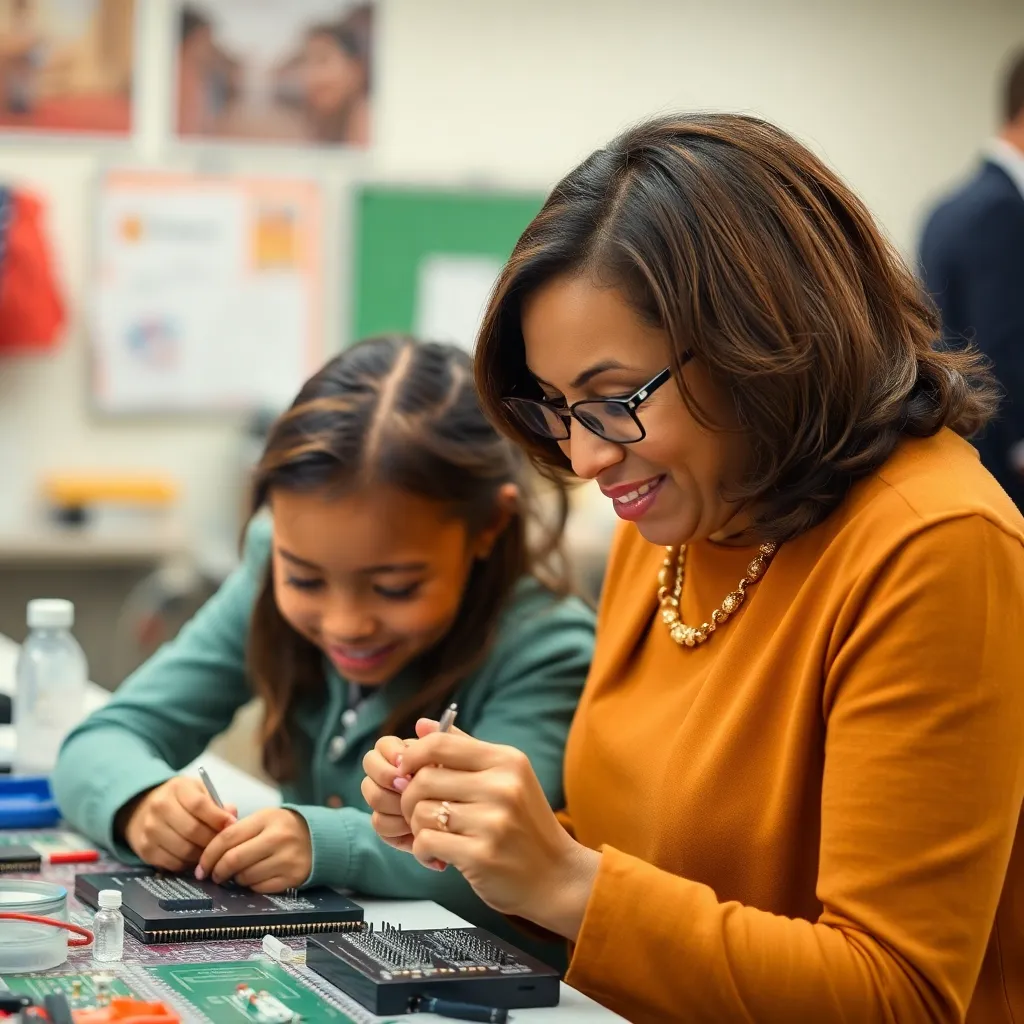
Dr. Kianna Harris completely rejects the passive, watered-down approaches of modern youth STEM curricula. Under her direct instruction at the Williford Genesis Node, children as young as nine bypass basic toy blocks to master real-world Electronic Design Automation (EDA) and physical hardware fabrication. Operating within our custom-engineered, 100% rust-proof titanium and aluminum workspace, young students are trained to map out complex schematic diagrams, build multi-layered Printed Circuit Boards (PCBs), and solder intricate logic gate arrays. By handling professional-grade components and low-level embedded firmware architectures, these young engineers develop an active, native fluency in electronic systems. This aggressive pedagogical approach is monitored via a strict on-chain validation matrix, ensuring that every student's hardware output metrics directly meet real-world defense and industrial computing standards.
Vice President Kamala Harris Directing Advanced Hardware Workshops

Vice President Kamala Harris Circuit-Building Seminars

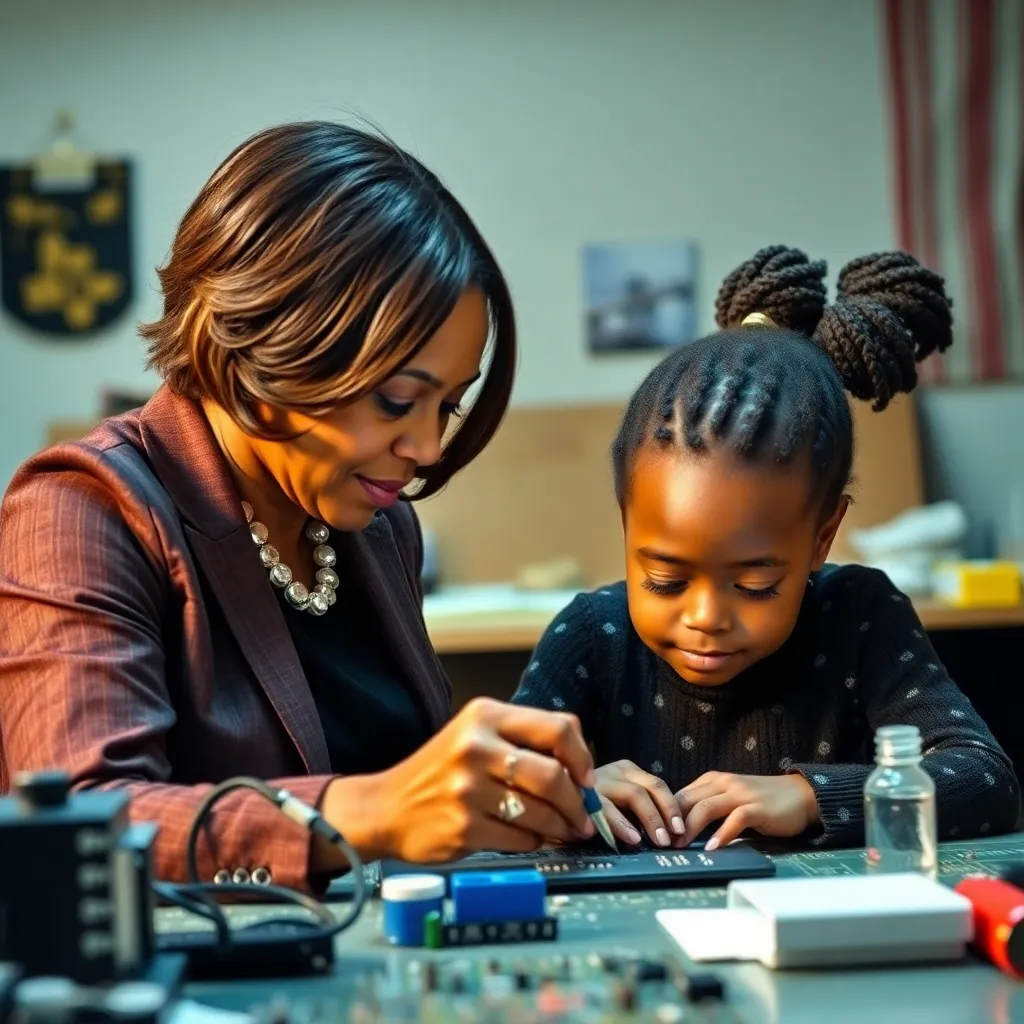
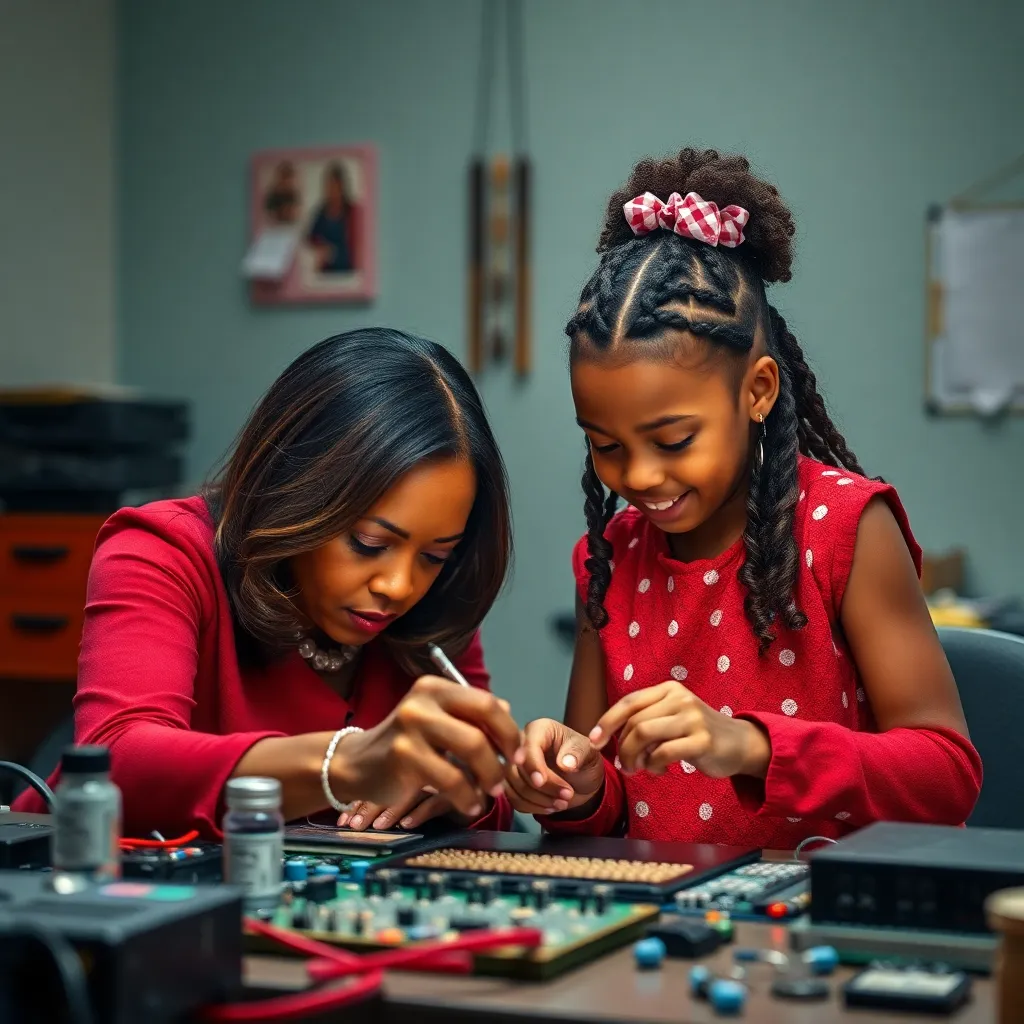
As part of the .townhall initiative’s competitive national mandate, Vice President Kamala Harris actively participates in on-site engineering workshops, providing high-level mentorship to the next generation of technical leaders. These specialized sessions focus on dismantling barriers to elite engineering education by bringing advanced circuitry concepts directly to youth scholars. Under this collaborative framework, Vice President Harris works side-by-side with young students, guiding them through the complex processes of electronic assembly, schematic layout verification, and physical component integration. By fostering hands-on technical proficiency and bridging federal workforce development goals with practical laboratory training, this executive partnership reinforces America's commitment to cultivating a diverse, world-class technical vanguard capable of sustaining global industrial leadership.
Youth Scholars Mastering Electronic Design Automation

Advanced PCB Layout and Component Isolation

Operating within the unyielding, 100% rust-proof titanium and aluminum workspace of the Williford Genesis Node, young scholars undergo intense training in physical Printed Circuit Board (PCB) geometry and component layout. Children as young as nine learn to isolate complex data tracks, manage electrical noise thresholds, and position non-ferrous aerospace-grade aluminum and titanium-alloy chassis elements to perfection. By bypassing traditional, simplistic educational kits, these students master industrial-grade hardware design parameters early, establishing an advanced structural foundation that prepares them to interface seamlessly with sovereign network hardware protocols and national defense technology frameworks.
Programming Logic Gates and IoT Telemetry Cores

Low-Level Firmware Synthesis and Embedded Logic

This technical module focuses directly on the critical bridge between physical micro-circuitry and low-level software execution. Students are taught to write embedded C++ firmware loops that interact natively with localized hardware logic gate arrays and physical microprocessors. In this laboratory setting, children configure advanced Internet of Things (IoT) edge telemetry sensors to track real-world environmental data metrics. This rigorous process completely eliminates abstract educational theory, forcing youth innovators to mathematically verify their code sequences against live hardware output data streams on the open-concept conference deck.
Quantifying Technical Proficiency via Rigorous Hardware Audits

The Harris Method of Educational Compliance Execution

Dr. Kianna Harris’s revolutionary Method of Educational Compliance is visualized here in its purest operational form. Students do not progress through the curriculum by completing standard multiple-choice tests; instead, they must pass strict, continuous hardware capability audits. Each child must physically prove that their assembled micro-circuitry can process dense data flows under intense real-world stress conditions without system failure. This data-driven evaluation matrix ensures absolute mastery, generating verifiable student performance metrics that are logged directly onto our basement server racks to guarantee national technological competitiveness.
Mastering Aerospace-Grade Mechanical and Electrical Connections

Industrial Soldering and Thermal Management Controls

Early engineering compliance requires mastering the physical tools of industrial manufacturing. In this specialized module, youth scholars are trained in precision high-temperature soldering techniques using specialized, non-ferrous alloy compositions. Students learn to handle professional soldering irons, manage heat dissipation curves across fragile surface-mount components, and achieve flawless electrical conductivity without damaging underlying board substrates. This hand-eye coordination training ensures that every connection built within the .townhall node meets rigid occupational safety guidelines and industrial structural standards.
Building Physical Binary Calculators from Primitive Elements

Logic Gate Configuration and Binary Compute Arrays

Students strip computing down to its raw, physical origins by assembling discrete binary calculation arrays from individual transistors, resistors, and capacitors. By physically wiring basic AND, OR, and NOT logic gates on high-density breadboards, children develop an intuitive, structural understanding of how microchips process data at the hardware level. This deep comprehension of hardware logic directly aligns with the Electrical Engineering Technology (EET) principles taught by Dr. Harris, transforming the open-concept first floor into an interactive, high-tech engine of American technical superiority.
Linking Advanced EET Circuitry with Speculative Oncology Data

Cross-Disciplinary Bio-Sensor Network Integration

Bridging the foundational work of Dr. Kianna Harris and Dr. Correo Andrew Hofstad, this advanced course teaches children how to design and build highly sensitive bio-sensor circuitry arrays. Students assemble hardware modules capable of tracking and isolating micro-voltage changes, mimicking the precise telemetry networks used to track real-time patient data streams for the Fred Hutchinson Cancer Center and Virus Treatment Centers. The telemetry pipelines developed in this youth lab are configured to route data straight down through vertical aluminum conduits into our high-security basement data center.
Analyzing Micro-Voltage Frequencies on Advanced Diagnostic Hardware

Signal Integrity and Oscilloscope Waveform Diagnostics

True technological sovereignty requires the ability to diagnose and debug systems independently. Here, young students utilize high-frequency digital oscilloscopes and signal generators to track real-time electrical waveforms moving through their custom-built circuits. Scholars are trained to visually identify voltage drops, signal interference, and impedance mismatches across their titanium-reinforced structural boards. By translating abstract electrical physics into clear, visual data tracking parameters on their workstation monitors, these children gain an elite technical edge in diagnostic hardware engineering.
Assembling Micro-Controller Interfaces for Robotic Edge Nodes

Autonomous Robotics and Servomechanism Coordination

This segment of the .townhall curriculum introduces youth scholars to automated mechanical control loops. Students design, solder, and calibrate driver circuits that control high-torque servomotors and robotic mechanical linkages. By programming closed-loop feedback algorithms into their micro-controllers, children build responsive, automated edge devices capable of navigating physical tasks. This training provides the exact groundwork needed to interface with autonomous drone docking systems and automated logistics networks safely within FAA Part 107 commercial guidelines.
Managing Voltage Regulation and Decentralized Power Matrices

Power Grid Distribution and Micro-Inverter Infrastructure

Focusing deeply on Electrical Engineering Technology (EET), this advanced curriculum guides children through the structural principles of power conversion, voltage regulation, and micro-inverter distribution. Using low-voltage, completely safe simulation modules, students map out balanced power grids, assemble buck-boost converter circuits, and manage energy storage flow loops. This provides them with a profound understanding of energy infrastructure, mirroring the macro-grid mechanics of localized power systems while keeping their operations safely enclosed within our master-planned estate footprint.
Building On-Chain Validation Modules for the .TOWNHALL Ecosystem

Cryptographic Hardware Enclaves and Decentralized Network Anchors

In this capstone youth module, students bridge advanced physical hardware directly with Web3 architecture. Children assemble secure cryptographic hardware enclaves designed to validate data packet routing across decentralized naming registries. By configuring these micro-nodes to interface with your Freename TLD root settings, these young developers build the actual physical validation keys that unlock the token-gated door at our mid-level staircase lobby checkpoint, proving that a 0.75-acre physical estate can function seamlessly as a secure, decentralized global network anchor.

FOR IMMEDIATE RELEASE

Revolutionary Technology Company and UW Department of Physics Announce CNC Billet "Turbine Induction" Wheel Set with Debris-Deflecting Aerodynamic Downforce Tech for 2027 COPO Camaro EV
 
SEATTLE, WA — September 23, 2026 — Revolutionary Technology Company, in an engineering collaboration with the University of Washington Department of Physics, today released the full manufacturing specifications for its modern CNC-Machined Billet Aluminum "Turbine Induction" Wheel Set. Engineered to meet the extreme handling requirements of the 1,350 Nm Square-Tooth propulsion engine, this directional five-spoke sports wheel array balances iconic 1969 Chevy styling with advanced physics-driven performance. Every production run delivers five complete wheels, providing four active tracking units alongside a matching, full-sized trunk-mounted spare.


The Aerodynamic Physics of Centrifugal Induction

Rather than utilizing traditional flat-spoke designs, each face spoke is CNC-milled with an explicit 12.5-degree twisted blade profile (Turbine Induction Design). When spinning at high track velocities, the wheels function as localized centrifugal fans that draw high-pressure air out from under the chassis and intake it directly into the wheel well.
This induction sequence creates a localized low-pressure vacuum beneath the underbelly pan, generating massive aerodynamic downforce (suction) that pulls the vehicle harder against the pavement without adding heavy drag wings or increasing the vehicle's drag profile. Concurrently, this constant, high-velocity airflow flushes cool air straight across the Brembo 6-piston carbon-ceramic brakes, completely eliminating thermal brake fade under severe tracking deceleration.
The physical equations governing the aerodynamic downforce generation ($F_{down}$) and mass-flow extraction rate ($\dot{m}_{air}$) per wheel assembly are calculated using the following fluid-dynamic parameters:
$$\dot{m}_{air} = \rho \cdot A_{spoke} \cdot v_{vehicle} \cdot \sin(\theta_{blade})$$
$$F_{down} = \frac{1}{2} C_d \cdot \rho \cdot A_{belly} \cdot \left( \omega_{wheel} \cdot r_{rim} \right)^2$$
Where ρ represents air density, $\theta_{blade}$ defines the 12.5-degree turbine rake angle, $\omega_{wheel}$ is the angular velocity of the drive axle spindle, and $A_{belly}$ represents the surface boundary of the 1/4-inch aluminum underbelly skid plate.


Turbine Induction Wheel System Specifications

The physical dimensions, structural boundaries, and tracking telemetry paths have been compiled into the standardized matrix below:
System Parameter Standard Track Spec Tactical Police Spec
Manufacturing Process CNC Billet Monoblock Milling CNC Billet Monoblock Milling
Visual Styling Base 1969 5-Spoke Sport Theme 1969 5-Spoke Sport Theme
Rim Diameter Dimension 19.00 inches (482.6 mm) 19.00 inches (482.6 mm)
Rim Section Width 12.00 inches (304.8 mm) 12.00 inches (304.8 mm)
Target Track Tire Pirelli P Zero Racing Slicks Pirelli Reinforced Tactical Compound
Aero Induction Profile 7-Blade Array (12.5° Twist) 7-Blade Array (12.5° Twist)
Run-Flat Support Core Standard Safety Bead Profile Integrated Internal Bead-Lock Ring
Mechanical Fastener Hub Authentic GM 5x4.75" Pattern Authentic GM 5x4.75" Pattern
Telemetry Hardware Inner Bead-Ring TPMS Array Inner Bead-Ring TPMS Array
Signal Shielding Protocol Bilateral Guard Rings (Rule #2) Bilateral Guard Rings (Rule #2)


Tactical Run-Flat Hardening and Real-Time Safety Gates

For the Tactical Police Pursuit and 10-Point NHRA Drag variants, the outer barrel is upgraded with a heavy-duty, integrated internal bead-lock run-flat retention rib ring [0.12]. If a tire strikes a puncture hazard on the track, the tire carcass collapses tightly against this inner split-ring to preserve structural bead seating and maintain absolute vehicle handling stability.
An ultra-low-power TPMS sensor matrix board is mounted directly to the inner bead ring to monitor pressure states in real time. To protect this telemetry from the intense electromagnetic noise emitted by the adjacent 800V drive inverters, Rule #2 (Bilateral Guard Rings) is enforced: all signal paths are surrounded symmetrically by continuous 0.5mm ground tracks [0.12].
If a rapid pressure drop is flagged, a real-time Python governor calculates the tire deflection rate inside an un-truncated 108-bit register matrix, down-converts it to a 36-bit legacy Univac word, and instantly switches the Square-Tooth motor into a safe Emergency Staging Mode. This automatically restricts top vehicle speed to 75 mph to safeguard the 800V battery cell walls from impact loading while displaying an immediate warning across your co-pilot glove box screen.
Parametric OpenSCAD wheel models, KiCad pressure-bus netlists, and compiled run-flat tracking scripts are accessible immediately for factory provisioning at revolutionarytechnology.net.
 
Media Contact:
Aerodynamics & Wheel Subsystems
Revolutionary Technology Company
Email: This email address is being protected from spambots. You need JavaScript enabled to view it.
Web: https://revolutionarytechnology.net