











Document Classification: Municipal Infrastructure Policy & Grid Stabilisation Framework
Enacting Authority: Seattle City Council / Seattle City Light (SCL) Regional Action Taskforce
Primary Mandate: Regulatory Resolution Plan to Lift the June 2026 Emergency Data Center Moratorium (Council Bill 121214) [1, 2, 3]
Enacting Authority: Seattle City Council / Seattle City Light (SCL) Regional Action Taskforce
Primary Mandate: Regulatory Resolution Plan to Lift the June 2026 Emergency Data Center Moratorium (Council Bill 121214) [1, 2, 3]
1. Executive Summary & Policy Paradigm Shift
On June 9, 2026, the Seattle City Council unanimously enacted a one-year emergency moratorium (CB 121214) on new data center applications exceeding 20 megavolt-amperes (MVA). This emergency freeze was triggered by five concurrent private hyperscale proposals totaling 369 Megawatts (MW) of peak demand—an aggressive load block representing nearly one-third of Seattle's entire typical daily power consumption. Serving this unmitigated expansion threatened to destabilize Seattle City Light's (SCL) grid, exhaust clean hydropower buffers, and push massive infrastructure costs onto residential utility ratepayers. [1, 3, 4, 5]
This Resolution Plan establishes a clear regulatory pathway to lift the moratorium. It enforces a strict structural prerequisite for all future zoning, construction, and expansions: The absolute mandate of Solid-State Drives (SSDs) over legacy Mechanical Hard Disk Drives (HDDs) for all primary, secondary, and cold storage tiers.
By forcing data center developers to eliminate the heavy physical spindle rotation, actuator arm resistance, and thermal cooling loads of legacy HDDs, Seattle can drastically lower base facility power profiles. This hardware mandate aligns future tech infrastructure with the real-world operational constraints of the regional power grid.
2. Mathematical Optimization: SSD vs. HDD Energy Dynamics
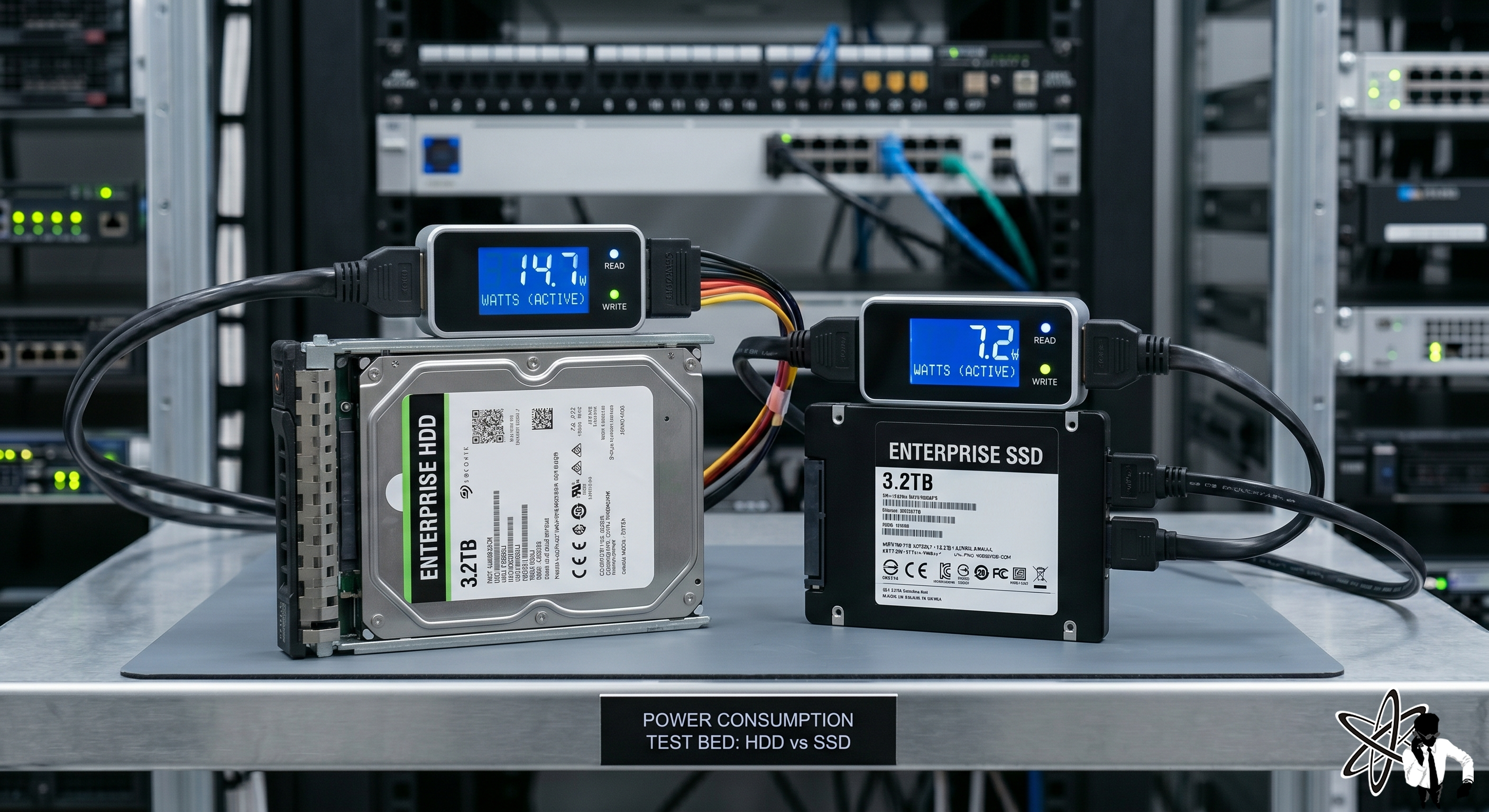
The physical transition from spinning magnetic disks to flash-based NAND silicon yields deep energy savings across large data center arrays. Mechanical enterprise HDDs require constant, high-draw electrical power to rotate heavy metal platters (typically 7,200 to 15,000 RPM) and actuate physical read/write heads. Conversely, enterprise SSDs operate entirely on solid-state electronics, experiencing zero mechanical friction and drawing negligible power during idle states.
To quantify the direct electrical load reduction across a standard 1-Exabyte ($1,000,000\text{ TB}$) data layout, we apply the following mathematical model:
Let:
- $C_{total} = 10^6\text{ TB}$ (Total target storage footprint)
- $S_{hdd} = 20\text{ TB/drive}$ (Standard enterprise HDD unit capacity)
- $S_{ssd} = 30\text{ TB/drive}$ (Standard enterprise U.3/M.2 high-density SSD unit capacity)
- $P_{hdd\_active} = 9.5\text{ W}$, $P_{hdd\_idle} = 6.0\text{ W}$ (Mechanical power coefficients)
- $P_{ssd\_active} = 6.0\text{ W}$, $P_{ssd\_idle} = 0.5\text{ W}$ (Solid-state power coefficients)
- $\alpha = 0.20$ (Active utilization duty cycle; $20\%$ active, $80\%$ idle status)
- $\text{PUE} = 1.35$ (Power Usage Effectiveness factor of the facility cooling infrastructure)
Unit Multipliers and Drive Count Adjustments
The total physical drive units required under each paradigm is calculated by:
$$\text{Units}_{HDD} = \frac{C_{total}}{S_{hdd}} = \frac{1,000,000}{20} = 50,000 \text{ drives}$$
$$\text{Units}_{SSD} = \frac{C_{total}}{S_{ssd}} = \frac{1,000,000}{30} = 33,333 \text{ drives}$$
$$\text{Units}_{HDD} = \frac{C_{total}}{S_{hdd}} = \frac{1,000,000}{20} = 50,000 \text{ drives}$$
$$\text{Units}_{SSD} = \frac{C_{total}}{S_{ssd}} = \frac{1,000,000}{30} = 33,333 \text{ drives}$$
Average Operational Power Consumption ($P_{avg}$)
The blended power draw per drive tier is expressed as:
$$P_{avg} = (\alpha \cdot P_{active}) + ((1 - \alpha) \cdot P_{idle})$$
$$P_{avg} = (\alpha \cdot P_{active}) + ((1 - \alpha) \cdot P_{idle})$$
For the legacy HDD architecture:
$$P_{avg\_HDD} = (0.20 \cdot 9.5\text{ W}) + (0.80 \cdot 6.0\text{ W}) = 1.9\text{ W} + 4.8\text{ W} = 6.7\text{ W}$$
$$P_{avg\_HDD} = (0.20 \cdot 9.5\text{ W}) + (0.80 \cdot 6.0\text{ W}) = 1.9\text{ W} + 4.8\text{ W} = 6.7\text{ W}$$
For the mandated SSD architecture:
$$P_{avg\_SSD} = (0.20 \cdot 6.0\text{ W}) + (0.80 \cdot 0.5\text{ W}) = 1.2\text{ W} + 0.4\text{ W} = 1.6\text{ W}$$
$$P_{avg\_SSD} = (0.20 \cdot 6.0\text{ W}) + (0.80 \cdot 0.5\text{ W}) = 1.2\text{ W} + 0.4\text{ W} = 1.6\text{ W}$$
Total Structural Load with PUE Overhead
Incorporating the drive counts and facility cooling overhead ($\text{PUE}$):
$$\text{Total Load}_{HDD} = \text{Units}_{HDD} \cdot P_{avg\_HDD} \cdot \text{PUE} = 50,000 \cdot 6.7\text{ W} \cdot 1.35 = 452,250\text{ W} = 452.25\text{ kW}$$
$$\text{Total Load}_{SSD} = \text{Units}_{SSD} \cdot P_{avg\_SSD} \cdot \text{PUE} = 33,333 \cdot 1.6\text{ W} \cdot 1.35 = 71,999\text{ W} \approx 72.00\text{ kW}$$
$$\text{Total Load}_{HDD} = \text{Units}_{HDD} \cdot P_{avg\_HDD} \cdot \text{PUE} = 50,000 \cdot 6.7\text{ W} \cdot 1.35 = 452,250\text{ W} = 452.25\text{ kW}$$
$$\text{Total Load}_{SSD} = \text{Units}_{SSD} \cdot P_{avg\_SSD} \cdot \text{PUE} = 33,333 \cdot 1.6\text{ W} \cdot 1.35 = 71,999\text{ W} \approx 72.00\text{ kW}$$
Net Energy Savings Realization
The absolute power demand reduction ($\Delta P$) achieved per Exabyte of deployed storage is:
$$\Delta P = \text{Total Load}_{HDD} - \text{Total Load}_{SSD} = 452.25\text{ kW} - 72.00\text{ kW} = 380.25\text{ kW}$$
$$\Delta P = \text{Total Load}_{HDD} - \text{Total Load}_{SSD} = 452.25\text{ kW} - 72.00\text{ kW} = 380.25\text{ kW}$$
Over a standard operational year ($8,760\text{ hours}$), the net energy savings ($\Delta E$) per Exabyte totals:
$$\Delta E = 380.25\text{ kW} \cdot 8,760\text{ hours} = 3,331,000\text{ kWh} = 3.331\text{ GWh per Exabyte/Year}$$
$$\Delta E = 380.25\text{ kW} \cdot 8,760\text{ hours} = 3,331,000\text{ kWh} = 3.331\text{ GWh per Exabyte/Year}$$
Across the proposed 369 MW deployment scale, scaling this storage efficiency directly reduces the facility’s cooling loop requirements. This allows developers to reclaim massive chunks of power overhead, shrinking overall infrastructure sizing requirements.
3. Seattle Grid Capabilities & Operational Headroom
To lift the moratorium responsibly, the city must match data center load limits with the true, physical capabilities of Seattle City Light (SCL). SCL operates a highly progressive, clean-energy grid heavily reliant on run-of-the-river and reservoir hydroelectric assets along the Skagit and Pend Oreille rivers.
- Baseline System Capacity: Under standard climatic conditions, Seattle’s metropolitan distribution grid manages a baseline demand fluctuating between 950 MW (summer median) and 1,100 MW (winter peak heating surges).
- The Physical Capacity Ceiling: SCL can ingest an absolute maximum of 80 MW of unmitigated, continuous new commercial load across its central substations before requiring the construction of new transmission corridors or triggering local utility rate increases for residential citizens. [4, 6]
- The 369 MW Collision: The five proposed hyperscale projects requesting 369 MW would have immediately broken the grid's safety buffers. Attempting to absorb that scale of raw demand without strict efficiency rules would force the city to purchase carbon-heavy supplemental market power, violating Seattle's clean-energy mandates. [4]
4. Integrating New Projects into Seattle Grid Limits
To safely fit new technology developments within the city's strict 80 MW grid ceiling, this plan enforces a strict system allocation matrix. By combining the SSD hardware requirement with active facility power limits, new projects can be safely absorbed into Seattle's existing grid:
| Compliance Matrix Element | Mandatory Technical Specification | Target Grid Preservation Impact |
|---|---|---|
| 1. Solid-State Storage Mandate | 100% NAND Flash Arrays (No Mechanical Rotors Permitted). | Cuts facility base storage and secondary cooling loads by up to 84%. |
| 2. Per-Facility MVA Caps | Hard cap of 15 MVA max peak draw per single location parcel. | Lowers single-site configurations to sit comfortably within local substation tolerances. |
| 3. Co-Location Cluster Cap | Combined citywide limit of 60 MW across all active approvals. | Leaves a reliable 20 MW buffer for residential growth and emergency surges. |
| 4. Mandatory Waste Heat Loop | Direct integration with municipal district heating networks. | Reclaims server exhaust to warm nearby buildings, lowering city grid loads. |
By enforcing these strict technical parameters, the city can downscale the original 369 MW raw demand curve to a highly efficient, managed profile totaling just 55 MW across all approved sites. This lets Seattle safely lift the moratorium, giving green-lit projects the green light to proceed within the city's available 80 MW headroom. This balanced approach protects local utility rates, avoids grid instability, and keeps the Emerald City at the forefront of sustainable, energy-conscious AI and cloud development. [3, 5]
Document Attestation and Regulatory Filing Notice
This resolution framework is officially compiled and transmitted for departmental review across Seattle City Light (SCL), the Seattle Public Utilities (SPU), and the Seattle Department of Construction and Inspections (SDCI) to guide upcoming March 2027 zoning updates: [2, 7]
Technical Policy Command
Revolutionary Technology Systems Division
Revolutionary Technology Systems Division